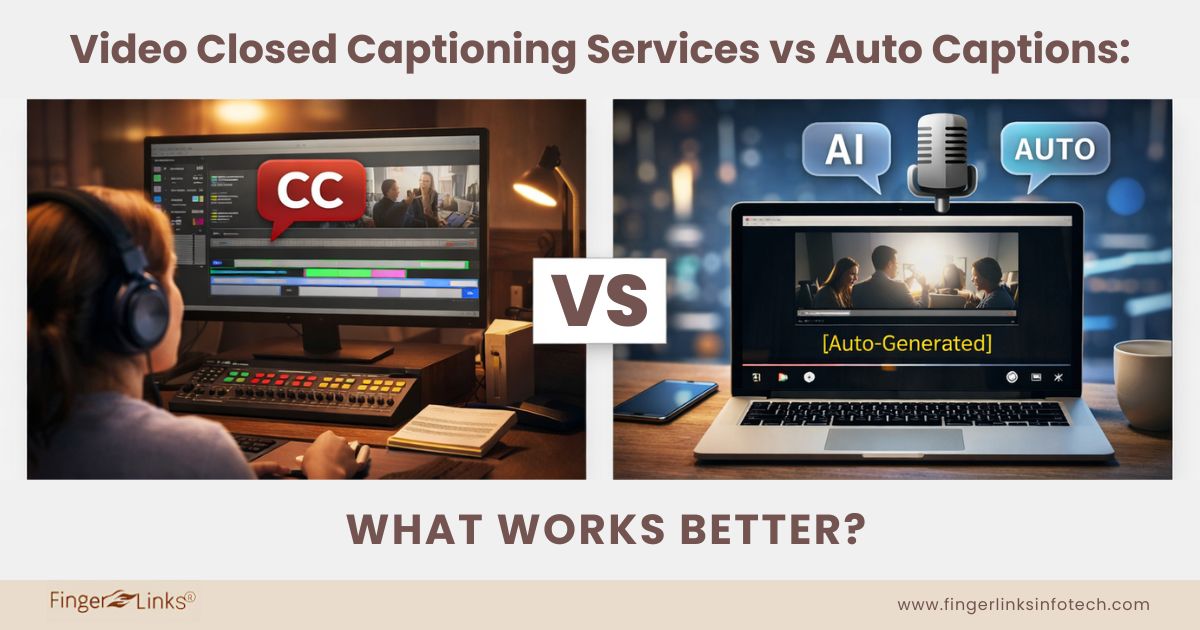
Video Closed Captioning Services vs Auto Captions: What Works Better?
- ⏰ April-03-2026 |
- ✍️ By Admin |
- 🏷️ In Captioning
Most businesses pick auto captions. Not because they work well - because they're free.
That decision quietly causes problems. Wrong words in client-facing videos. Staff training content that makes no sense. Legal compliance gaps nobody noticed until it was too late.
This blog is a straight breakdown. What auto captions actually do, what professional video closed captioning services deliver instead, and which one your business should be using.
Auto Captions: The Real Picture
YouTube generates them automatically. So does Zoom. So do Teams.
Upload a video, the AI listens, text appears on screen. No one reviews it. No one fixes anything. It goes live as-is.
That process sounds efficient. It isn't.
Here's what actually happens with auto captions on professional content:
-
A speaker with any kind of accent? The captions turn into guesswork.
-
Industry terms, product names, medical or legal language? Usually wrong.
-
Two or three people speaking? No labels, no separation, just a wall of text.
-
Background noise or poor mic quality? The AI starts filling in words that were never said.
The accuracy numbers are not good. Most research puts auto caption error rates at 20 to 40 percent. Run the math on a 10-minute video - that's potentially hundreds of errors your audience is reading.
And here's the part that really stings - someone still has to fix all of that. Auto captions aren't free once your editor spends three hours cleaning them up.
What Professional Video Closed Captioning Services Look Like
A trained human goes through the audio. Every word checked. Every speaker identified. Punctuation added correctly. Timing synced so captions match exactly when each word is spoken.
Sometimes AI tools help with the first draft. But a person always reviews the output before it leaves.
The accuracy exceeds 99 percent. The file complies with FCC regulations, ADA standards, or any applicable accessibility law in your area and industry. You get a finished product, not a rough draft that needs another hour of your time.
For businesses producing training videos, product demos, legal content, e-learning courses, or anything a customer will watch - this is the only option that makes sense.
Here's a direct comparison:
|
Auto Captions |
Professional Video Closed Captioning Services |
|
|
Accuracy rate |
60–80% |
99%+ |
|
Accents and dialects |
Unreliable |
Handled consistently |
|
Technical terminology |
Frequently incorrect |
Transcribed accurately |
|
Speaker identification |
Rarely included |
Standard |
|
ADA / FCC compliance |
Not guaranteed |
Fully compliant |
|
Post-editing required |
Almost always |
Rarely needed |
|
Cost |
Free |
Per-minute fee |
The Time Cost Nobody Mentions
Professional captioning has a per-minute fee. Auto captions don't. That much is true.
But what happens after auto captions are generated?
Someone combs through the transcript. Fixes the errors. Adds punctuation. Re-syncs anything that's out of time. Checks speaker labels don't exist and adds them manually. Does it again on the next video. And the one after that.
A 20-minute corporate training video with messy audio can take two to three hours to fix properly. For a team producing content regularly, that editing time stacks up fast.
Professional video closed captioning services come back accurate. Review, approve, upload. That's the whole process.
The "free" option isn't always the cheaper one.
Pairing Captioning With Transcription and Voice-Over
Most businesses caption a video and stop there. There's more available.
Pair video closed captioning services with professional transcription services and the same video now produces a full written transcript. That becomes a blog post, an internal training document, a searchable knowledge base article, or SEO content without any extra recording.
When you add voice-over services, the video now reaches audiences in other languages via dubbed audio rather than merely translated subtitles. One production. Multiple markets.
This is how content teams stretch their budget without producing more raw material from scratch.
Fingerlinks Infotech handles all of this in one place - see how their language services work here.
Captions and SEO - Worth Understanding
Google and YouTube cannot watch a video. They read the text attached to it.
Accurate captions give search engines clean, readable content to index. That directly affects how well the video ranks on both platforms.
Auto captions with a 30 percent error rate hand search engines corrupted text. Rankings suffer. Discoverability drops. The video gets less reach than it should.
Professional video closed captioning services fix this. Stack them with transcription services and there's now a full transcript available for crawling too - not just a caption file. More indexable content means better visibility across search.
When Auto Captions Are Fine
They're not useless. There are situations where auto captions make sense:
-
An internal meeting recording that stays within the team
-
A rough edit being reviewed before post-production
-
A quick informal clip where brand reputation isn't on the line
That's about where it ends. Public content, customer-facing videos, educational or compliance material, anything attached to your brand in a serious way - auto captions are not the right tool for that job.
Bottom Line
Auto captions exist for convenience. Professional video closed captioning services exist for accuracy, compliance, and credibility.
For a business where the content matters and it almost always does the choice isn't really close.
Want captions done right, fast, and to the right standard? Talk to the Fingerlinks Infotech team here.
Frequently Asked Questions
Q1. What is the difference between closed captions and auto-generated captions?
Ans. Closed captions are produced or reviewed by trained professionals. They deliver 99%+ accuracy, include correct punctuation, speaker identification, and meet ADA and FCC legal requirements. Auto-generated captions are produced by AI with no human review. Error rates typically sit between 20–40%, and legal compliance is not guaranteed.
Q2. Are auto captions good enough for professional business videos?
Ans. No. For public-facing or branded content, auto captions fall short. They struggle with accents, technical language, and multi-speaker audio. Any business producing professional video content: training, marketing, compliance, e-learning should use professional video closed captioning services instead.
Q3. Do businesses legally need closed captions on their videos?
Ans. In many situations, yes. The ADA and FCC require accurate captions on public-facing websites, educational platforms, and broadcast media. Auto captions do not reliably meet these standards. Professional video closed captioning services ensure the output is fully compliant with relevant accessibility regulations.
Q4. How much do professional video closed captioning services cost?
Ans. Pricing is typically charged per minute of video. Rates vary based on turnaround speed, audio quality, and content complexity. The per-minute cost is higher than free auto captions, but businesses avoid post-editing hours and compliance exposure, which makes professional captioning more cost-effective across a full content workflow.
Q5. Can transcription services be combined with video captioning?
Ans. Yes, and it makes a significant difference. Using transcription services alongside video closed captioning services produces both an accurate caption file and a complete written transcript. That transcript can be repurposed as a blog post, training guide, SEO article, or internal document - multiplying the value of a single video.
Q6. How do video closed captioning services help with SEO?
Ans. Search engines read text, they cannot process video directly. Accurate captions give Google and YouTube clean, indexable content tied to your video. Auto captions with errors degrade this quality. When professional video closed captioning services are paired with transcription services, both the caption file and written transcript become crawlable, improving search rankings and discoverability across platforms.
.jpg)
.jpg)