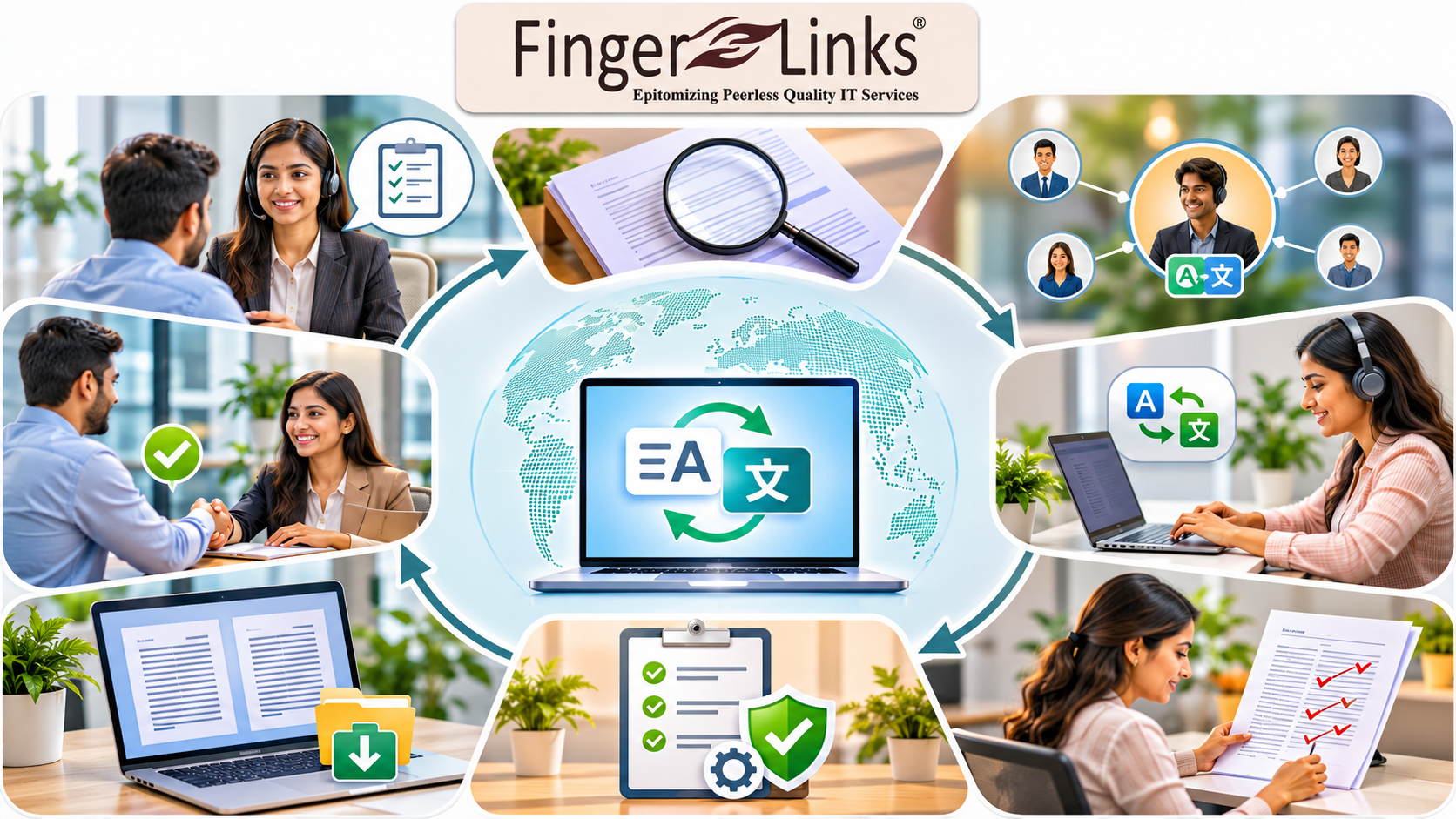
Behind Every Accurate Translation: The Complete Professional Translation Workflow at FingerLinks.
- ⏰ November-05-2026 |
- ✍️ By Admin |
- 🏷️ In Translation
Translation is more than converting words from one language into another. It is a structured process that requires linguistic knowledge, subject-matter understanding, cultural awareness, and careful quality assessment. Every translated document must communicate the original message accurately while maintaining its intended meaning, tone, and context. At FingerLinks, we follow a systematic professional translation workflow to help businesses and individuals communicate effectively across different languages and regions.
From the initial assessment of source documents to the final delivery of translated content, every stage plays an important role in maintaining translation quality, consistency, and readability.
1. Understanding Client Requirements
Every translation project begins with understanding the client's expectations and project requirements. Before starting the translation, we identify the source language, target language, document type, subject area, intended audience, and purpose of the content.
Different documents require different translation approaches. For example, legal agreements require precise terminology, technical manuals need subject-specific language, and marketing materials must communicate the intended message in a natural and culturally appropriate manner.
Understanding these requirements helps establish the project's scope, expected quality standards, formatting preferences, and delivery timelines.
2. Source Document Assessment
Once the requirements are established, the source documents are reviewed to understand their content, structure, and complexity. This assessment helps identify industry-specific terminology, technical expressions, abbreviations, tables, references, and formatting elements that require special attention.
The original document may contain scanned text, handwritten content, images, charts, or complex layouts. Identifying these elements in advance helps determine the appropriate translation approach and prevents important information from being overlooked.
A proper source assessment also helps identify potential language challenges and terminology requirements before the translation process begins.
3. Translator Selection and Project Allocation
Selecting the right translator is essential for achieving accurate results. Translation projects are allocated based on language proficiency, subject-matter knowledge, and experience with the relevant content category.
For instance, legal documents require translators familiar with legal terminology and documentation, while medical and technical materials demand an understanding of specialized terminology and industry conventions.
At FingerLinks, appropriate translator allocation helps ensure that the content is handled with the linguistic and subject-specific knowledge required by the project.
4. Translation and Contextual Accuracy
The actual translation stage involves converting the source content into the target language while preserving its original meaning and intent. However, direct word-for-word translation may not always communicate the same message effectively.
Translators must consider sentence structure, grammar, terminology, cultural references, expressions, and the context in which the content is being used.
For business documents, the translated content should maintain a professional tone. For marketing materials, the language should sound natural and connect with the intended audience. For legal and technical documents, terminology and meaning must remain consistent throughout.
The objective is to produce translated content that is accurate, understandable, and appropriate for its intended purpose.
5. Terminology Management and Language Consistency
Maintaining consistent terminology is an important part of professional translation, particularly when working on large documents or multiple files belonging to the same project.
The same technical terms, product names, legal expressions, and industry-specific phrases should be translated consistently throughout the content.
Terminology references and project-specific glossaries can help translators maintain uniform language usage. This becomes especially important when multiple translators are involved in a single project or when clients require regular translation updates.
Consistent terminology improves readability and helps maintain the professional quality of translated documents.
6. Proofreading and Linguistic Review
After the initial translation is completed, the content undergoes proofreading and linguistic review. This stage focuses on identifying grammatical mistakes, spelling errors, punctuation issues, incorrect word usage, sentence structure problems, and inconsistencies.
The reviewer also checks whether the translated content accurately reflects the original document without unnecessary additions, omissions, or changes in meaning.
Cultural appropriateness and natural language flow are also considered to ensure that the translated material reads smoothly for the target audience.
This review helps identify errors that may not have been noticed during the initial translation stage.
7. Quality Assurance and Document Verification
Quality assurance is an important checkpoint before the translated documents are approved for delivery. It involves reviewing the overall document to verify completeness, formatting, terminology, consistency, and alignment with the client's requirements.
The translated version is compared against the source document to identify missing sections, incorrect figures, inconsistent names, formatting differences, and other potential issues.
Special attention is given to tables, headings, numbering, dates, references, and document layouts. These checks help ensure that the translated document is professionally presented and ready for its intended use.
8. Final Formatting and Delivery
Once the translation and quality checks are completed, the document is prepared for final delivery. The formatting is reviewed to ensure that headings, paragraphs, tables, numbering, and other structural elements are properly organized.
The completed files are delivered in the agreed format and within the specified timeline. Client-specific instructions regarding file formats, naming conventions, and document presentation are also considered during the final preparation stage.
A well-organized delivery process ensures that clients can use their translated documents without unnecessary additional formatting or corrections.
9. Handling Client Feedback and Revisions
Translation projects may sometimes require adjustments based on client feedback, terminology preferences, or changes to the original content.
A clear revision process helps address these requirements while maintaining consistency throughout the translated document. Feedback can also help improve terminology references and establish language preferences for future assignments.
This stage supports better communication between the client and the translation service provider and helps ensure that the final output meets the agreed expectations.
Why Choose FingerLinks for Translation Services?
At FingerLinks, we understand that accurate communication is essential for businesses operating across different languages and markets. Our professional translation workflow focuses on understanding project requirements, selecting suitable linguistic resources, maintaining contextual accuracy, and conducting thorough quality checks.
We provide translation and language-related solutions for different content categories, including business documents, legal materials, technical content, educational documents, and general communications.
Our structured approach emphasizes:
-
Accurate meaning and contextual understanding.
-
Appropriate subject-matter expertise.
-
Consistent terminology and language usage.
-
Careful proofreading and linguistic review.
-
Document completeness and formatting checks.
-
Timely delivery based on project requirements.
Conclusion
Behind every successful translation is a well-organized process that combines linguistic expertise with careful review and quality management. Each stage, from source document assessment and translator allocation to proofreading and final delivery, contributes to the accuracy and usability of the translated content.
At FingerLinks, our focus is on providing professional translation solutions through a systematic workflow that helps clients communicate their messages clearly across languages.
Looking for reliable translation services for your business or documents? Partner with FingerLinks for professional multilingual translation support.