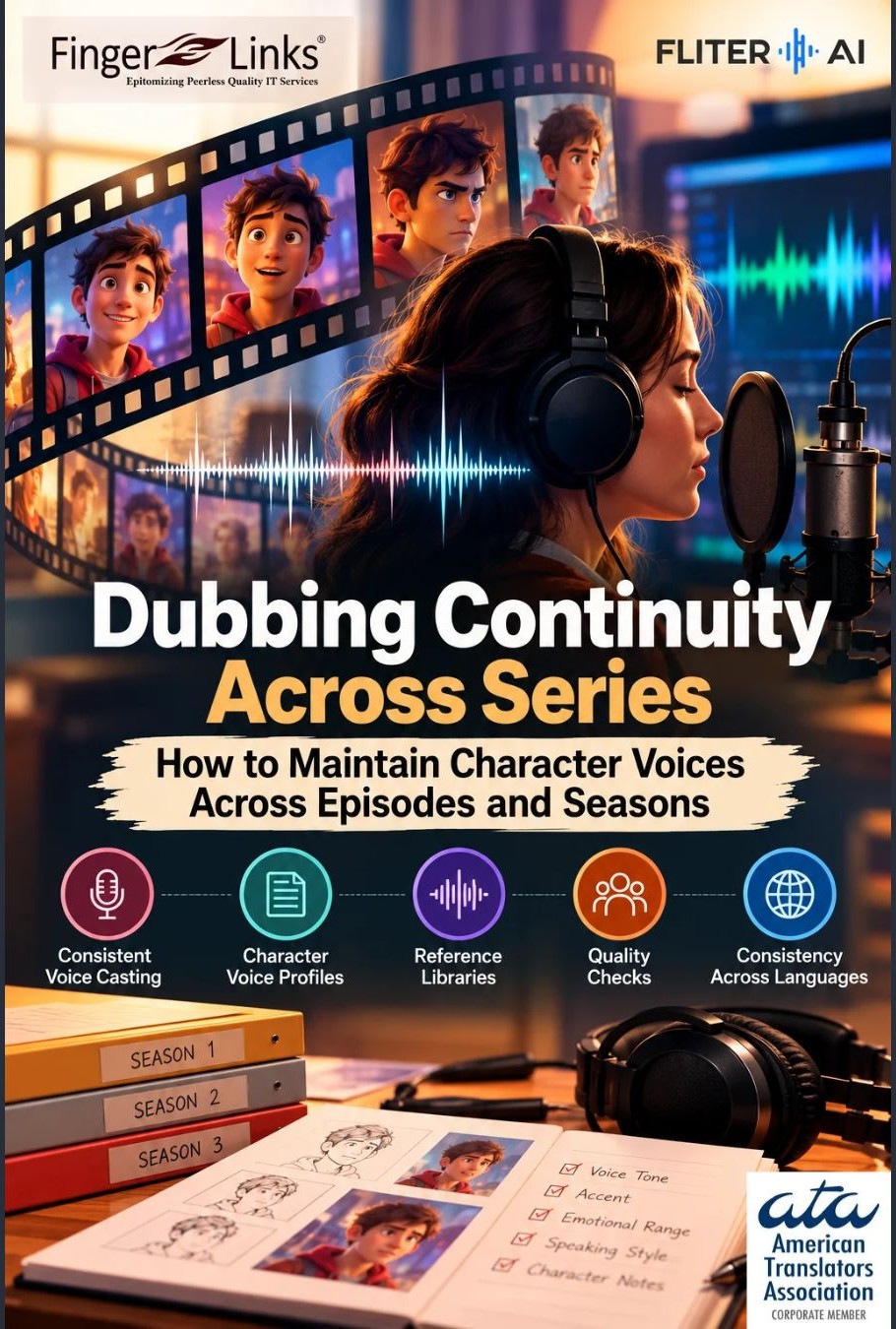
Dubbing Continuity Across Series: How to Maintain Character Voices Across Episodes and Seasons
- ⏰ October-29-2026 |
- ✍️ By Admin |
- 🏷️ In Dubbing
Dubbing continuity is an essential part of producing high-quality multilingual content for television series, animated shows, web series, films with sequels, and streaming platforms. When viewers follow a story across multiple episodes and seasons, they develop a strong connection with the characters, including their voices, accents, emotional expressions, and distinctive speaking styles. Maintaining these vocal characteristics throughout a series helps preserve character identity and ensures that audiences enjoy a consistent and immersive viewing experience in every language.
Unlike dubbing a standalone video, dubbing a long-running series requires careful planning, detailed documentation, and ongoing coordination between voice actors, directors, sound engineers, translators, and quality control teams. Episodes may be recorded weeks or months apart, production teams may change, and characters may experience significant emotional or personality developments. Without a structured continuity process, these changes can lead to noticeable differences in voice quality, pronunciation, pacing, and emotional delivery.
Why Voice Continuity Matters in Series Dubbing
A character's voice is an important part of their identity. Viewers become familiar with the way a character speaks, expresses emotions, pronounces certain words, and interacts with other characters. Even small variations in these characteristics can affect how audiences perceive the character.
For example, a confident lead character may have a firm, energetic speaking style, while a supporting character may be recognized by a softer tone, a particular accent, or a distinctive rhythm. If these characteristics change unexpectedly between episodes, the dubbed version may feel inconsistent, even when the dialogue is translated accurately.
Voice continuity is particularly important in animated series, where vocal performance helps communicate a character's personality and emotional state. It is equally important in drama series, comedy shows, documentaries with recurring presenters, and other episodic content. Consistency helps audiences remain connected to the story without being distracted by changes in the dubbed dialogue.
Common Challenges in Maintaining Character Voice Consistency
One of the major challenges is the time gap between recording sessions. An actor's vocal condition, energy, pronunciation, and delivery can vary from one session to another. Changes in recording equipment, studio acoustics, microphone positioning, and sound processing can also create differences in the final audio.
Voice actor replacement is another important consideration. When an original dubbing artist becomes unavailable, the replacement must reproduce the character's established vocal qualities as closely as possible while maintaining a natural performance. This requires suitable casting, reference recordings, and direction.
Other challenges include changes in translators or dubbing directors, inconsistencies in character names and pronunciation, evolving character relationships, and differences in dialogue adaptation across episodes. These issues can become more complex when several languages and production teams are involved.
1. Creating Character Voice Profiles
A character voice profile is a reference document that records the defining vocal characteristics of each recurring character. It helps ensure that every recording team understands how the character should sound.
A comprehensive profile can include vocal pitch, tone, accent, pronunciation preferences, speaking speed, rhythm, emotional range, and distinctive expressions. It may also document how the character speaks in different situations, such as during arguments, emotional conversations, humorous moments, or action scenes.
For example, a character who usually speaks calmly may become louder and more forceful during a confrontation. The voice profile should distinguish between the character's normal delivery and temporary emotional changes so that actors can reproduce both consistently.
These profiles serve as a practical reference for voice actors, dubbing directors, translators, and quality control editors. Updating them when a character develops or changes over time helps maintain continuity without making the performance feel static.
2. Maintaining Consistent Voice Casting
Voice casting has a direct influence on continuity. Whenever possible, retaining the same voice actor across episodes and seasons provides a stable vocal identity for the character. Familiarity with the character also allows actors to build on previous performances and portray emotional development more naturally.
However, scheduling conflicts, availability issues, production changes, or long gaps between seasons can make consistent casting difficult. In these situations, casting teams should select replacements based on vocal suitability, acting ability, accent, and the ability to reproduce the character's established delivery.
Reference recordings from earlier episodes can help replacement actors understand the character's usual pitch, pronunciation, pace, and emotional style. Directors can also provide specific feedback and conduct test recordings before production begins.
The goal is not necessarily to make every performance identical. Instead, the objective is to preserve the qualities that make the character recognizable while allowing the actor to deliver an authentic and expressive performance.
3. Building a Voice Reference Library
A centralized voice reference library helps production teams maintain access to previously approved recordings and character information. It can include selected dialogue clips, pronunciation guides, character voice profiles, approved emotional performances, and notes from earlier recording sessions.
These references are particularly useful when a new season begins after a long break or when multiple studios work on different episodes. Rather than relying on memory alone, actors and directors can compare new recordings with established performances.
The library should be organized by character, episode, language, and scene type wherever practical. Clear file naming, version control, and access permissions can prevent confusion and ensure that teams use the correct reference material.
A well-maintained library also supports quality control by providing a reliable basis for comparing vocal characteristics across episodes. It becomes especially valuable for large projects involving numerous recurring characters and multiple language versions.
4. Preserving Emotional Continuity Across Episodes
Voice continuity involves more than matching pitch and accent. Emotional consistency is equally important because characters develop relationships, experience conflicts, and respond to changing events throughout a series.
A character who has experienced a major loss, for example, may speak more quietly or hesitate more often in subsequent scenes. A character who becomes more confident may gradually adopt a stronger delivery. These changes should reflect the storyline rather than occur accidentally because of differences between recording sessions.
Dubbing directors can support this process by reviewing relevant scenes from earlier episodes, documenting important character developments, and providing actors with information about the story's emotional progression.
Actors should understand what has happened to the character before recording each scene. This context helps them deliver dialogue that feels connected to previous events while preserving the character's established personality.
5. Standardizing Pronunciation, Accent, and Dialogue Delivery
Pronunciation inconsistencies can become particularly noticeable in long-running series. Character names, fictional locations, technical terms, recurring phrases, and culturally specific expressions may be pronounced differently by different actors or production teams.
A standardized pronunciation guide helps avoid these problems. It should document approved pronunciations, accent requirements, frequently repeated expressions, and any language-specific conventions established for the project.
Translators and dialogue adapters should also coordinate with directors to ensure that translated dialogue remains consistent with earlier episodes. Recurring catchphrases and signature expressions deserve special attention because audiences may immediately recognize changes in their wording or delivery.
At the same time, dialogue should remain natural in the target language. Maintaining continuity does not mean forcing literal translations when they sound awkward. The objective is to preserve the character's intent, personality, and recognizable speech patterns while ensuring that the localized dialogue works naturally for its audience.
6. Coordinating Multiple Dubbing Studios and Teams
Large series may involve multiple studios, directors, recording schedules, and localization teams. This creates a risk of inconsistent performance standards, particularly when episodes are produced simultaneously or distributed across different regions.
A shared production workflow can reduce these differences. Teams should work from approved scripts, common character profiles, consistent pronunciation references, and documented recording instructions.
Centralized project management also helps track episode status, casting decisions, pending corrections, and final approvals. When a change is made to a character's pronunciation or performance guidelines, the updated information should be communicated to every team working on the project.
Regular communication between localization managers, dubbing directors, sound engineers, and quality control editors helps identify issues before they spread across several episodes or language versions.
7. Using Technology to Support Voice Continuity
Modern audio tools can help dubbing teams organize, compare, and review recordings more efficiently. Audio waveform comparisons, pitch analysis, voice activity inspection, and automated quality checks can help identify differences in vocal delivery or recording conditions.
Artificial intelligence can also support the analysis of selected vocal characteristics and flag recordings that may require further review. These tools are useful when managing large volumes of episodic content, but automated analysis should not replace professional listening and acting judgment.
A voice may differ slightly because the character is frightened, excited, exhausted, or speaking in a different environment. Such differences may be intentional and necessary for the story. Technology can highlight potential inconsistencies, while directors and quality control specialists determine whether the variation is appropriate.
Any use of voice cloning or synthetic voice technology should follow applicable consent, contractual, privacy, and usage requirements. Human oversight is important to protect performance quality and ensure that the final dialogue fits the character and narrative.
8. Implementing a Strong Quality Control Process
Quality control is one of the most effective ways to identify and correct voice continuity issues before episodes are delivered. Reviewers should compare new recordings with approved references and evaluate whether the characters remain consistent in voice, pronunciation, emotional delivery, and dialogue style.
A practical review process can include the following checks:
-
Voice identity: Confirm that the character remains recognizable in tone, pitch, and vocal texture.
-
Pronunciation: Check names, recurring expressions, terminology, and accent consistency.
-
Performance: Evaluate pacing, emphasis, emotional intensity, and speaking rhythm.
-
Audio quality: Identify differences in volume, background noise, microphone characteristics, and sound processing.
-
Dialogue continuity: Confirm that recurring phrases and character-specific expressions align with earlier episodes.
-
Story context: Ensure that vocal changes reflect the character's development rather than accidental performance differences.
When an inconsistency is identified, reviewers should document the issue, reference the relevant approved recording, and provide clear corrective instructions. Maintaining a record of recurring problems can also help teams improve future recording sessions and reduce repeated revisions.
9. Managing Voice Continuity Across Multiple Languages
Multilingual dubbing adds another layer of complexity because the same character must remain recognizable across different languages, even when the voice actors, pronunciation systems, and cultural expressions differ.
The goal is not to make every language sound identical. Each language has its own rhythm, intonation, and natural speaking conventions. Instead, the character's essential personality, emotional range, confidence, humor, and overall vocal identity should remain consistent across language versions.
Localization teams should establish language-specific character profiles that preserve these core qualities while accommodating natural differences in delivery. Shared character notes, scene references, and approved performance examples help different teams understand the intended characterization.
Coordination is especially important for characters who use signature phrases, distinctive speech patterns, or culturally significant forms of address. Translators, dialogue adapters, directors, and voice actors must work together to maintain the same narrative intent and character identity without compromising the naturalness of the target language.
10. Adapting Continuity as Characters Evolve
Maintaining consistency does not mean preventing characters from changing. Long-running series often portray characters growing older, becoming more confident, experiencing trauma, or developing new relationships. Their voices may need to reflect these changes.
Production teams should distinguish between intentional character development and unintended vocal variation. A gradual change in confidence, emotional control, or speaking rhythm may be appropriate, while an unexplained change in accent or basic vocal identity may confuse audiences.
Character profiles should therefore be treated as evolving documents rather than permanent restrictions. When a significant change is introduced, the director can record the reason for the adjustment and establish updated references for subsequent episodes.
This approach preserves continuity while allowing voice performances to develop naturally alongside the story.
Conclusion
Dubbing continuity across series requires a combination of careful planning, consistent voice casting, detailed documentation, effective communication, and reliable quality control. From creating character voice profiles and maintaining reference libraries to coordinating multilingual studios and reviewing recordings, each stage contributes to a coherent viewing experience.
Technology can make continuity checks more efficient, but experienced voice actors, dubbing directors, and quality control professionals remain essential for preserving emotional authenticity and character identity. A well-organized continuity process helps audiences recognize and connect with their favorite characters throughout every episode and season.
For professional dubbing providers such as FingerLinks Infotech, maintaining consistent vocal quality across multilingual productions is an important part of delivering reliable localization services. By combining structured workflows, language expertise, and careful review, dubbing teams can help ensure that characters retain their distinctive personalities and emotional impact, regardless of the language in which their stories are presented.