Data Drift Detection: How Automation Identifies Changes in Business Data Patterns Before They Become Problems
- ⏰ September-04-2026 |
- ✍️ By Admin |
- 🏷️ In Data Automation
Businesses rely on data every day to manage customers, process transactions, forecast demand, generate reports, and make important decisions. But business data does not remain constant. Customer behavior changes, product information gets updated, transaction volumes fluctuate, and new sources of data are introduced.
These changes can gradually affect the quality and reliability of business data. A process that worked correctly yesterday may begin producing unexpected results when the underlying data changes.
This is where automated data drift detection becomes valuable.
What Is Data Drift?
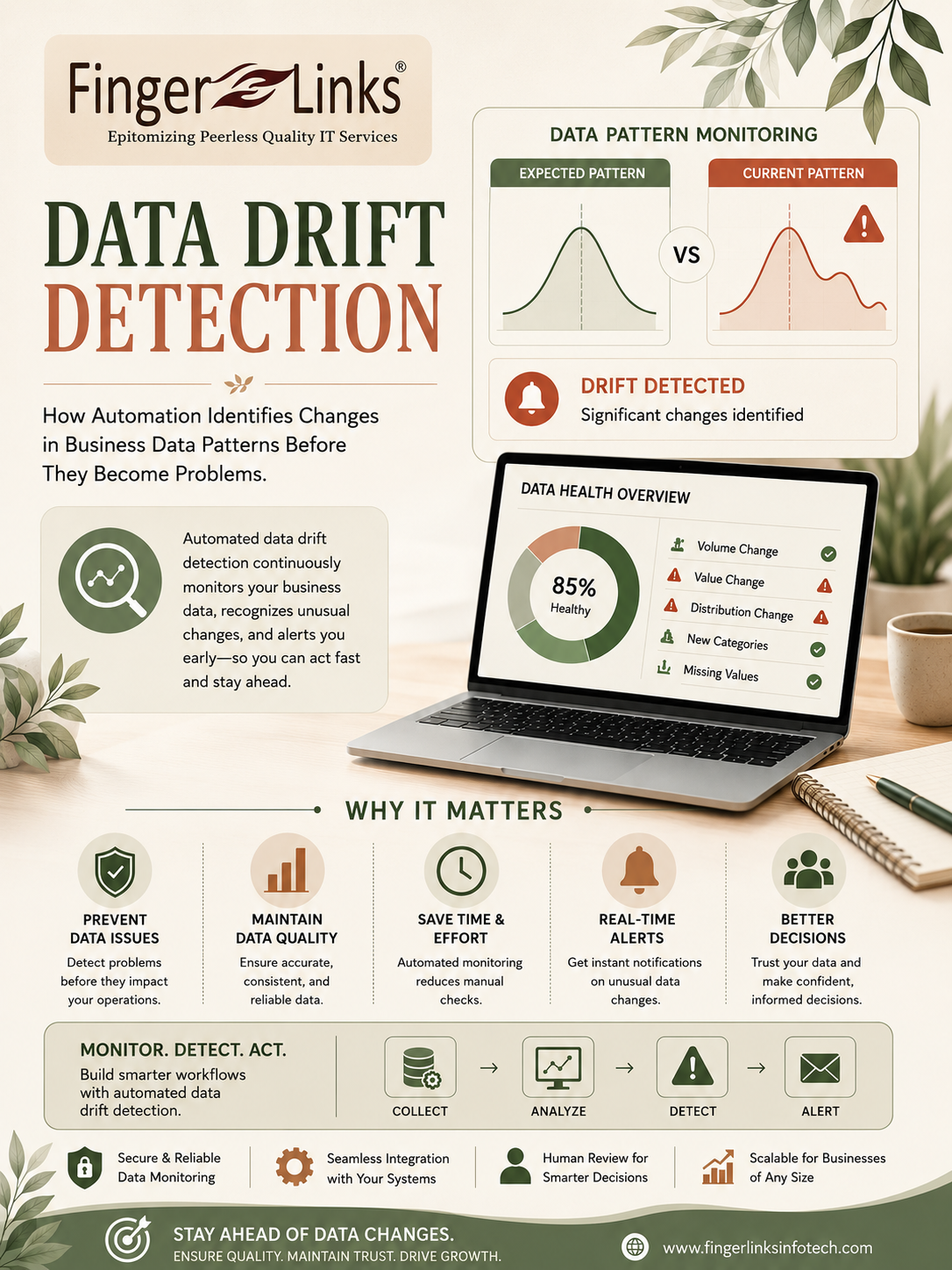
Data drift occurs when the characteristics or patterns of incoming data change over time compared with the data a business previously processed or expected.
For example, an organization may normally receive customer records with a predictable distribution of locations, transaction amounts, product categories, or customer types. If those patterns suddenly change, an automated monitoring system can flag the difference.
Data drift can involve:
- Changes in data distributions
- Unexpected changes in values
- Changes in data volume
- New or missing categories
- Changes in customer or transaction patterns
- Variations in field formats
- Sudden increases or decreases in specific data types
Not every change indicates a problem. The purpose of drift detection is to identify significant changes early so teams can investigate them.
Why Data Drift Can Become a Business Problem
Small changes in business data can sometimes go unnoticed until they affect downstream systems.
For example, a company may experience:
- Incorrect reports
- Unusual analytics results
- Failed automated workflows
- Inaccurate customer segmentation
- Unexpected inventory calculations
- Problems with forecasting
- Inconsistent records between systems
- Reduced reliability of automated decision-making
Without continuous monitoring, teams may only notice the problem after it has already affected business operations.
How Automation Detects Data Drift
Automated data monitoring systems can continuously compare current data against historical or expected patterns.
A typical workflow can:
Collect → Analyze → Compare → Detect → Alert → Review
The system establishes expected data patterns and continuously checks new datasets against those benchmarks. When a significant deviation occurs, an alert can be generated for the appropriate team.
This removes the need for employees to manually inspect large datasets every day.
Examples of Data Drift Detection
Consider an e-commerce company that normally processes approximately 10,000 orders per day. If the volume suddenly falls to 3,000 orders, an automated monitoring system can identify the unusual change.
Similarly, a financial operation may normally receive transactions within a particular range. A sudden shift in transaction values could trigger an automated review.
Other examples include:
- A sudden increase in incomplete customer records
- A major change in product-category distribution
- Unexpected changes in invoice values
- A sudden increase in duplicate records
- New values appearing in previously standardized fields
- A significant drop in incoming data from one source
Benefits of Automated Data Drift Detection
1. Early Problem Identification
Businesses can identify unusual data behavior before it spreads to downstream processes.
2. Continuous Monitoring
Automated systems can monitor data continuously instead of relying on periodic manual checks.
3. Reduced Manual Effort
Teams spend less time comparing datasets and searching for unusual patterns.
4. Better Data Quality
Identifying changes early helps organizations maintain more consistent and reliable data.
5. Faster Response
Automated alerts allow responsible teams to investigate issues quickly.
6. More Reliable Automation
When automated processes depend on changing data, drift monitoring helps ensure those processes continue operating as expected.
Data Drift Detection and Data Automation
Data drift detection can become an important component of a broader data automation strategy. Instead of simply moving, transforming, or processing data automatically, businesses can build monitoring into the workflow itself.
For example:
Data Source → Automated Processing → Quality Checks → Drift Detection → Alert → Human Review → Corrective Action
This creates a more proactive approach to data management.
The Role of Human Review
Automation can identify unusual patterns, but not every change is an error. A sudden increase in sales, for example, could be caused by a successful marketing campaign rather than a data problem.
Human reviewers can therefore investigate alerts, determine whether the change is expected, and take corrective action when necessary.
This combination of automated monitoring and human oversight helps businesses respond to genuine data issues without treating every variation as an error.
Conclusion
Data changes are a normal part of modern business operations, but unnoticed data drift can create problems across automated workflows, analytics, reporting, and decision-making.
Automated data drift detection gives businesses a practical way to continuously monitor changing data patterns, identify significant deviations, and alert teams before small issues become larger operational problems.
For organizations handling large and continuously changing datasets, integrating drift detection into their data automation processes can provide an additional layer of visibility, control, and data quality.