Human-in-the-Loop Automation: Why Some Business Data Processes Still Need Human Review.
- ⏰ September-03-2026 |
- ✍️ By Admin |
- 🏷️ In Data Automation
Businesses are increasingly using automation to process large volumes of data, reduce repetitive work, and improve operational efficiency. Automated systems can extract information from documents, classify data, validate records, identify patterns, and move information between different business systems with minimal manual effort.
However, automation does not mean that every process should operate without human involvement.
Some business data requires judgment, context, verification, and decision-making that automated systems may not always handle correctly. This is where Human-in-the-Loop (HITL) automation becomes important.
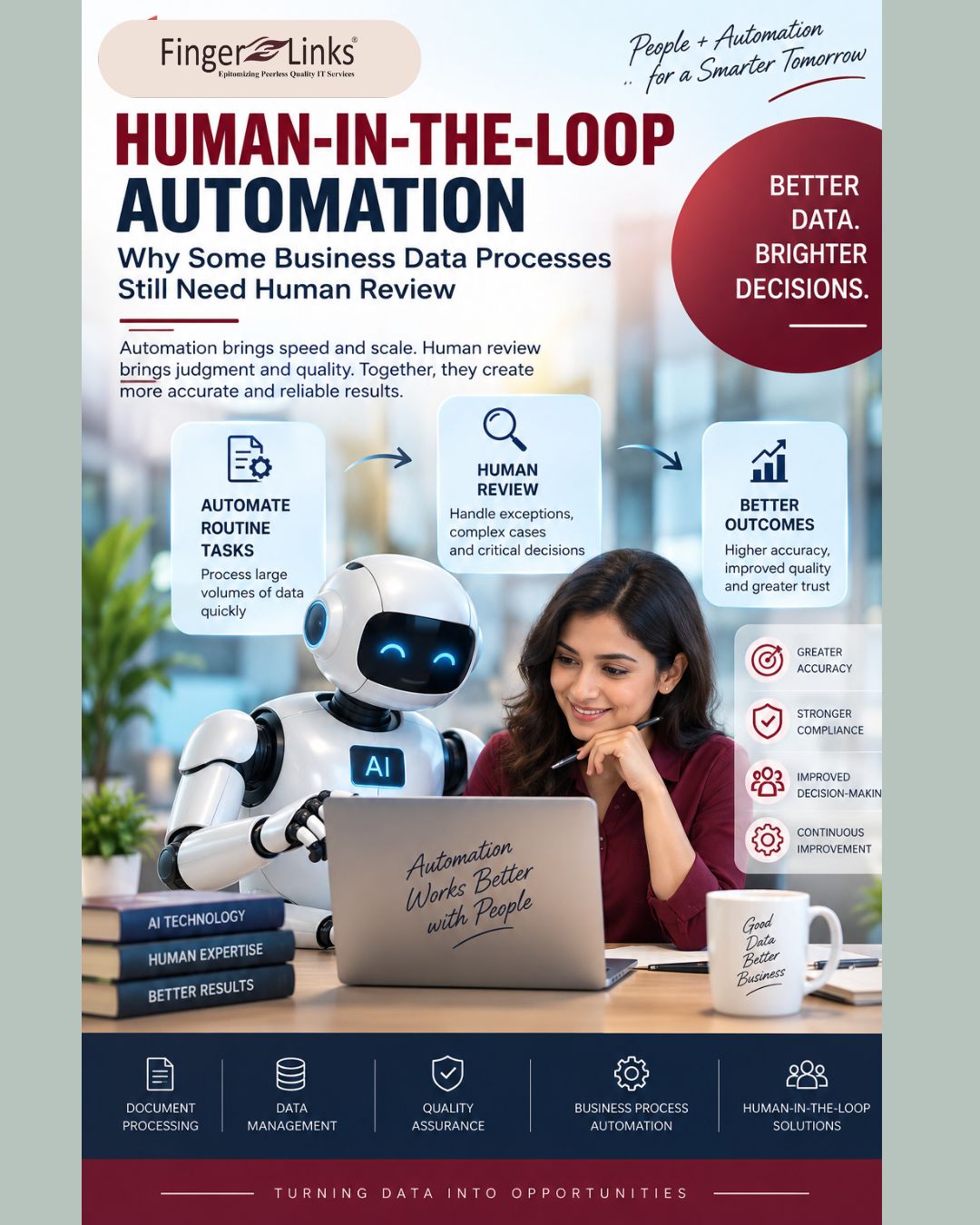
Human-in-the-loop automation combines the speed and scalability of automated systems with the experience and judgment of human professionals. Instead of completely replacing people, the system automatically handles routine tasks while directing uncertain, complex, or high-impact cases to a human reviewer.
For example, an automated document-processing system may successfully extract information from thousands of invoices. However, if one invoice contains an unusual format, missing information, or conflicting values, the system can flag it for human verification instead of allowing potentially incorrect information to enter the business database.
This approach can be particularly valuable in areas such as data entry, document processing, insurance, finance, healthcare, legal services, customer information management, and data annotation.
A well-designed HITL workflow typically follows a simple process: the system receives the data, performs automated processing, evaluates the result, identifies exceptions or low-confidence outputs, and sends those cases to a human reviewer. Once reviewed, the corrected information can continue through the workflow.
Human review can help address several common challenges in automated data processing. It can improve data accuracy, identify unusual cases, reduce the impact of incorrect automated decisions, and provide an additional quality-control layer.
Another important advantage is that human feedback can help organizations improve their automation systems over time. When reviewers repeatedly identify the same types of errors, those insights can be used to improve business rules, workflows, models, or validation processes.
The key is not to add humans to every step. Excessive manual intervention can reduce the efficiency gained through automation. Instead, businesses should identify where human judgment provides the greatest value and automate the remaining repetitive work.
The future of business automation is therefore not necessarily about choosing between humans and machines. A more practical approach is to create workflows where automation handles volume and repetitive tasks while people handle exceptions, judgment, and quality control.
By implementing human-in-the-loop automation strategically, businesses can build data processes that are faster, more scalable, and more reliable while maintaining the human oversight required for critical decisions.