AI Dubbing Quality Control: How Human Review Improves Accuracy, Emotion, and Cultural Relevance
- ⏰ September-19-2026 |
- ✍️ By Admin |
- 🏷️ In Dubbing
AI has changed the way businesses and content creators approach multilingual video production. With AI-powered dubbing, a single video can be adapted into multiple languages without recording every version entirely from scratch. This can make multilingual content production faster and more scalable.
However, producing a dubbed version is not simply a matter of converting the original dialogue into another language and generating a voice. A successful dubbed video needs to sound natural, communicate the intended meaning, preserve the emotions of the original performance, and fit the timing of the visuals.
This is where AI dubbing quality control becomes important.
Human review can work alongside AI technology to identify issues that automated systems may overlook. By combining automated dubbing with professional quality checks, businesses can produce multilingual content that sounds more natural and remains faithful to the original message.
What Is AI Dubbing Quality Control?
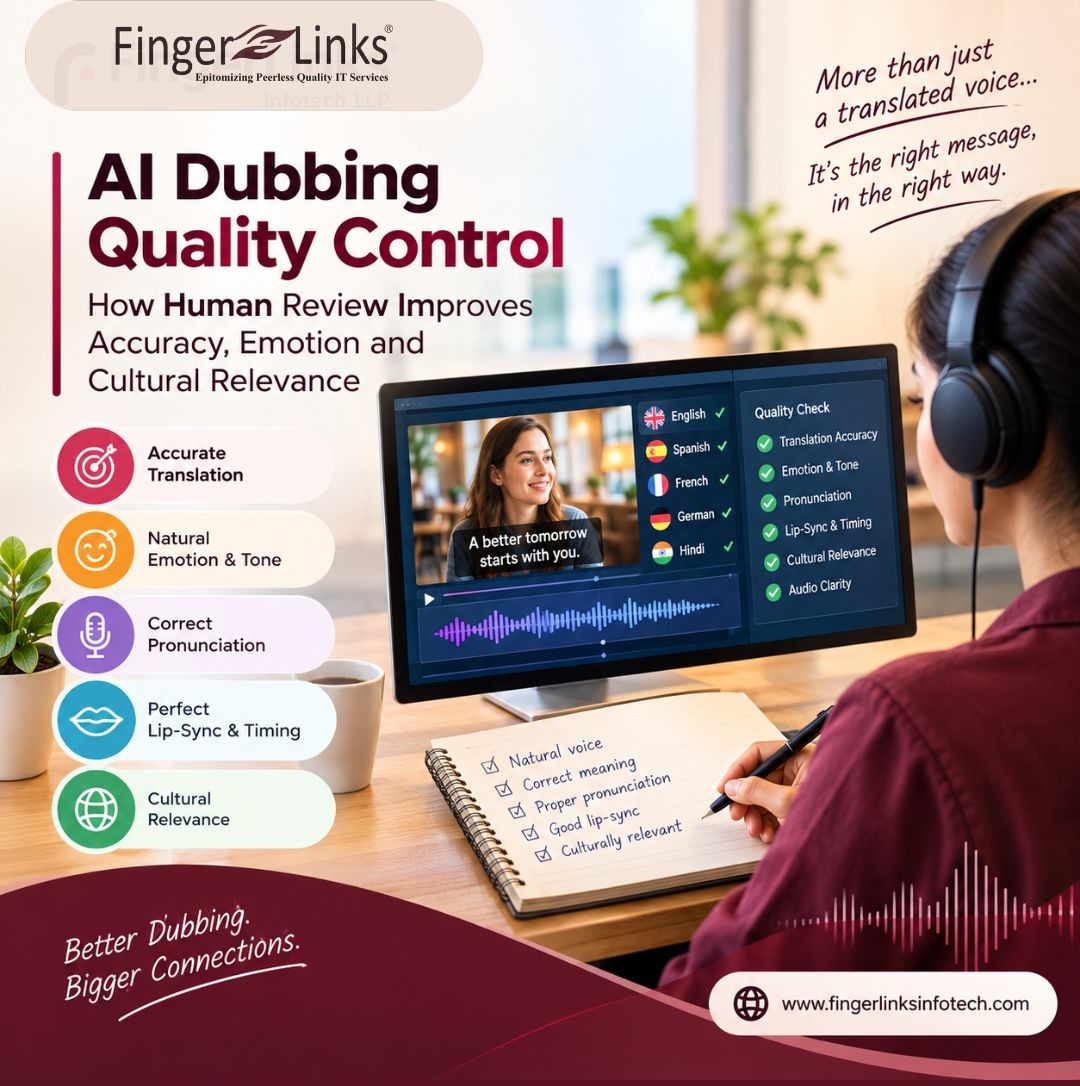
AI dubbing quality control is the process of reviewing an AI-generated dubbed version to identify and correct problems before the content is published.
AI can assist with several stages of dubbing, including translation, voice generation, timing, and audio production. However, automated output may still contain errors involving context, pronunciation, emotion, cultural references, or synchronization.
Quality control provides an additional layer of review.
A typical quality-control process may examine:
- Translation accuracy
- Context and meaning
- Pronunciation
- Voice quality
- Emotional delivery
- Character consistency
- Speech timing
- Lip synchronization
- Cultural suitability
- Audio clarity
- Names, places, and technical terminology
The objective is not simply to determine whether the words are correct. The goal is to make sure the finished audio works naturally within the complete video.
Why AI-Generated Dubbing Needs Human Review
AI systems can process large amounts of content quickly, but language is highly dependent on context.
A sentence can have different meanings depending on the situation, speaker, tone, or relationship between characters. A direct translation may therefore be grammatically correct while still sounding unnatural or communicating the wrong idea.
Human reviewers can examine the dialogue within its visual and conversational context.
For example, a phrase used as a joke may require a different translation from its literal meaning. Similarly, an expression that works naturally in one language may sound awkward when translated word-for-word into another.
Human quality control helps identify these problems before they reach the audience.
1. Checking Translation Accuracy
The first stage of dubbing quality control is reviewing whether the translated dialogue accurately represents the original content.
Reviewers can compare the source dialogue with the dubbed script and check:
- Meaning
- Context
- Sentence structure
- Terminology
- Names
- Numbers
- Dates
- Locations
- Product names
- Industry-specific terminology
This is particularly important for corporate, educational, legal, healthcare, and technical content where small language errors can change the intended meaning.
AI can provide a fast first version, while human review helps ensure that the final dialogue communicates the correct message.
2. Preserving Emotion and Character Personality
Dubbing is more than replacing one language with another. The voice needs to communicate the emotion behind the dialogue.
A character may sound:
- Excited
- Angry
- Nervous
- Humorous
- Sad
- Confident
- Concerned
- Surprised
- Calm
An AI-generated voice may pronounce the words correctly but fail to reproduce the emotional intention of a particular scene.
Human reviewers can listen to the dubbed performance alongside the original and identify differences in emotional delivery.
For example, an emotionally intense scene should not sound flat or overly neutral. Likewise, a serious business presentation should not have an exaggerated or inappropriate vocal style.
3. Verifying Pronunciation
Pronunciation is another important quality-control area.
AI-generated voices can sometimes mispronounce:
- Personal names
- Company names
- Brand names
- Locations
- Medical terminology
- Legal terminology
- Technical terms
- Abbreviations
These errors can be particularly noticeable in professional content.
Human reviewers can identify incorrect pronunciations and provide corrections so that the final voice track sounds natural and professional.
4. Maintaining Lip-Sync and Timing
A good dubbed performance should fit the visual sequence.
The translated sentence may contain more or fewer words than the original. As a result, a direct translation can sometimes produce dialogue that is too long or too short for the available speaking time.
Quality control can examine whether:
- Dialogue begins at the correct point
- Speech ends naturally
- Pauses match the scene
- Dialogue fits the character's visible actions
- The voice does not overlap incorrectly with other speakers
- Timing remains comfortable for the listener
Where necessary, the translated script can be adjusted without changing its intended meaning.
This helps create a more natural viewing experience.
5. Checking Cultural Relevance
Language and culture are closely connected.
A phrase, joke, idiom, reference, or expression that works in one market may not have the same meaning in another. Some references may also require adaptation to make sense to the target audience.
Human reviewers familiar with the target language and culture can identify content that sounds unnatural or confusing.
Cultural review can involve:
- Idioms
- Humor
- Local expressions
- Social references
- Names
- Measurements
- Currency
- Regional terminology
- Cultural references
The purpose is not to change the original message unnecessarily, but to communicate it naturally to the intended audience.
6. Maintaining Consistent Character Voices
For videos containing multiple characters, voice consistency is essential.
A character's voice should remain recognizable throughout the content. Changes in pitch, speaking style, or vocal characteristics can make the dialogue feel inconsistent.
Quality control can check whether:
- The same character maintains a consistent voice
- Different characters remain distinguishable
- Speaking styles remain appropriate
- Voice characteristics are maintained across scenes
- Emotional changes sound intentional
This becomes particularly important for films, animation, games, series, and long-form educational content.
7. Identifying Unnatural AI Speech
AI-generated voices have become increasingly natural, but certain issues may still be noticeable.
Examples include:
- Unnatural pauses
- Incorrect emphasis
- Repetitive intonation
- Unusual pronunciation
- Flat emotional delivery
- Inconsistent pacing
- Artificial-sounding sentence endings
Human listeners can often identify these problems more easily when listening to the complete scene rather than evaluating individual sentences.
A quality-control reviewer can flag sections that require additional voice or script adjustments.
8. A Human-in-the-Loop Dubbing Workflow
A practical AI dubbing workflow can combine automation with professional review.
Step 1: Source Preparation
The original video and dialogue are reviewed to understand the content, speakers, timing, and intended audience.
Step 2: Translation
The source dialogue is translated into the target language while considering context and terminology.
Step 3: AI Voice Generation
The translated script is converted into the required voice track using an appropriate AI voice.
Step 4: Synchronization
The generated dialogue is aligned with the video's timing and visual sequence.
Step 5: Human Quality Review
A reviewer checks translation, pronunciation, emotion, timing, voice consistency, and cultural suitability.
Step 6: Corrections
Any identified issues are corrected through script adjustments, pronunciation changes, timing modifications, or voice regeneration.
Step 7: Final Audio and Video Review
The completed dubbed video is reviewed from beginning to end before delivery.
This human-in-the-loop approach combines the speed of AI with the contextual understanding of professional reviewers.
Benefits of AI Dubbing With Quality Control
Combining AI dubbing with human review can provide several practical benefits.
Faster Multilingual Production
AI can accelerate repetitive production tasks, allowing multiple language versions to be prepared more efficiently.
Better Language Accuracy
Human reviewers can identify contextual errors and improve translated dialogue.
More Natural Voice Delivery
Reviewers can identify sections where the generated voice does not match the intended emotion or character.
Improved Cultural Adaptation
Target-language reviewers can help ensure that expressions and references are appropriate for the intended audience.
Consistent Quality
A defined quality-control process provides consistent checks across different languages and projects.
Better Audience Experience
Natural dialogue, appropriate emotion, and accurate synchronization can make dubbed content easier and more enjoyable to watch.
Which Content Benefits From Dubbing Quality Control?
Quality control is particularly valuable for content where communication accuracy and audience experience are important.
This includes:
- Films and television programs
- YouTube videos
- Corporate videos
- E-learning courses
- Product demonstrations
- Marketing videos
- Advertisements
- Training materials
- Social media videos
- Animated content
- Gaming content
- Webinars and presentations
For professional and commercial content, a small language or pronunciation error can affect how the audience perceives the entire production.
AI and Human Expertise Work Together
AI dubbing can significantly simplify multilingual content production, but technology does not eliminate the need for language expertise.
The strongest workflow is often a combination of both.
AI can help with speed, scalability, repetitive processing, and voice generation. Human professionals can contribute contextual understanding, language expertise, cultural awareness, emotional interpretation, and final quality judgment.
This combination allows businesses and content creators to scale multilingual production while maintaining greater control over the quality of the finished content.
Conclusion
AI dubbing is creating new possibilities for businesses, entertainment companies, educators, and content creators that want to reach audiences across language barriers. However, generating a voice track is only one part of the dubbing process.
Translation accuracy, pronunciation, emotional delivery, timing, lip synchronization, character consistency, and cultural relevance all influence the quality of the final product.
AI dubbing quality control provides the additional review needed to identify these issues before content reaches the audience.
By combining AI-powered production with human review, organizations can build a dubbing workflow that balances speed, scalability, linguistic accuracy, and natural communication.
As multilingual video content continues to grow, quality control will remain an important part of creating dubbed content that feels natural and communicates the original message effectively.