How Poor Data Annotation Can Affect AI Training and Performance?
- ⏰ August-15-2026 |
- ✍️ By Admin |
- 🏷️ In Data Automation
Data Annotation Quality: What Happens When AI Training Data Is Incorrect?
Artificial intelligence systems are only as reliable as the data used to train them. While much attention is given to AI models, algorithms, and computing power, the quality of the underlying training data is equally important. Data annotation quality plays a critical role in determining whether an AI system can accurately recognize patterns, classify information, and perform its intended task.
Data annotation involves labeling or tagging information such as images, videos, text, audio, and other datasets so that machine learning models can understand and learn from them. When these annotations are incorrect, incomplete, or inconsistent, the model may learn the wrong patterns and produce unreliable results.
What Is Data Annotation Quality?
Data annotation quality refers to the accuracy, consistency, completeness, and relevance of labels assigned to training data.
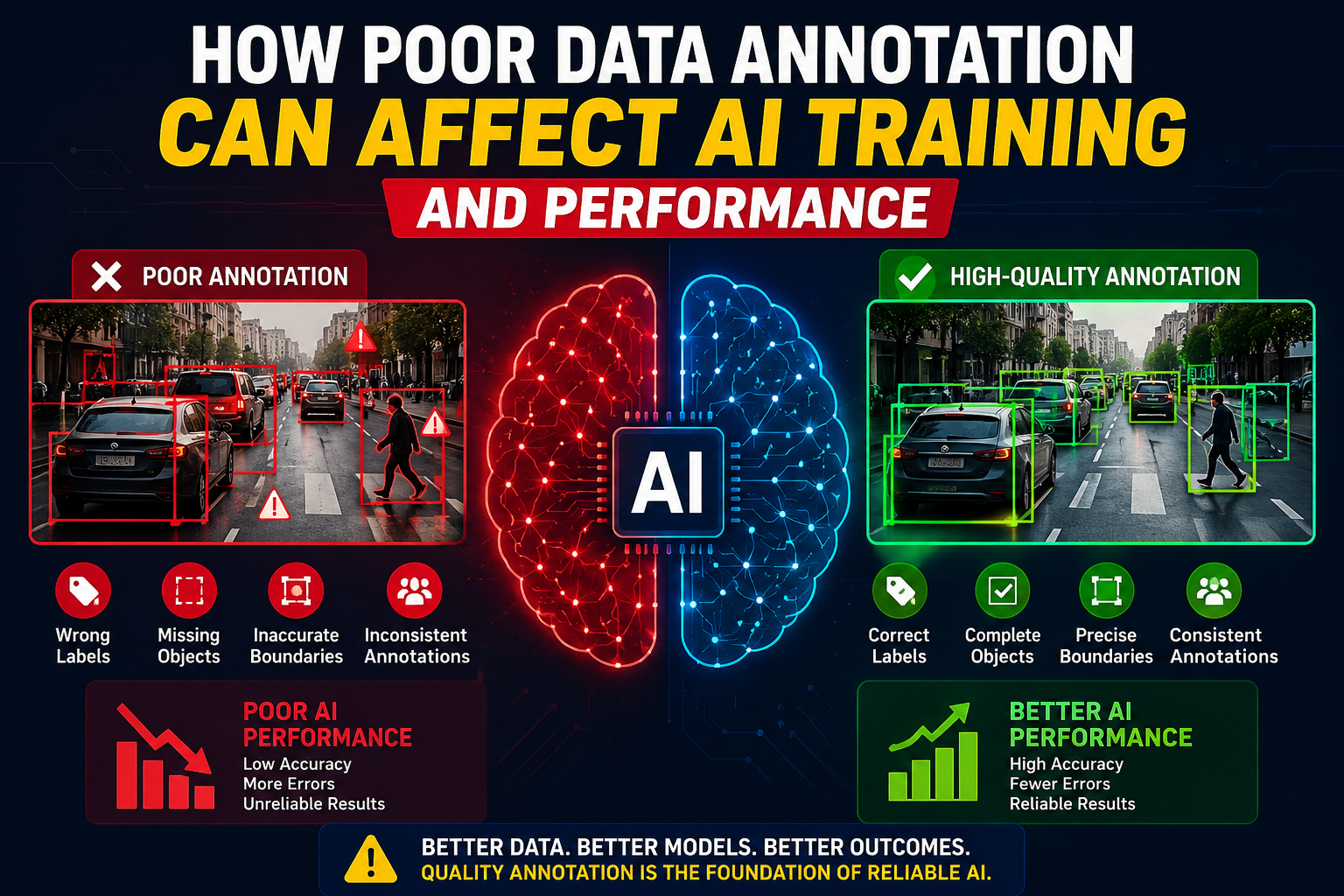
For example, in an image annotation project, a vehicle may need to be identified using a bounding box and labeled as “car.” If the box is incorrectly positioned, the vehicle is missed entirely, or it is labeled as another object, the training dataset contains inaccurate information.
Similarly, in text annotation, incorrectly identifying the sentiment of a customer review or assigning the wrong category to a document can introduce errors into the dataset.
Research on annotation quality has identified issues including inconsistent labels, missing annotations, localization errors, and disagreements between annotators as important challenges in dataset creation.
What Happens When AI Training Data Is Incorrect?
1. The AI Model Learns the Wrong Patterns
Machine learning models learn from examples. If those examples contain incorrect labels, the model may learn relationships that do not accurately represent the real world.
For instance, if images of trucks are repeatedly labeled as cars, an object-detection model may eventually struggle to distinguish between the two categories.
The problem is not necessarily with the AI algorithm itself. The model may simply be learning from incorrect information.
2. Prediction Accuracy Can Decrease
Poor annotation can result in incorrect predictions after the model is deployed.
Depending on the application, this could mean:
-
Incorrect object detection
-
Wrong classification
-
Missed objects
-
False positives
-
Incorrect text categorization
-
Poor speech or language recognition
-
Unreliable recommendations
Studies on imperfect annotations have found that annotation noise can affect model training and performance, although the extent of the impact varies according to the task, type of error, and dataset.
3. Bias Can Be Introduced Into AI Systems
Annotation problems are not limited to simple labeling mistakes. If certain categories, situations, or groups are consistently underrepresented or incorrectly labeled, the resulting dataset can become biased.
For example, an object-recognition dataset that contains mostly daytime images may perform less reliably in nighttime conditions. Similarly, a dataset with insufficient examples of certain categories may produce weaker predictions for those categories.
This makes dataset diversity and consistency important parts of annotation quality.
4. Model Evaluation Can Become Misleading
A model needs reliable validation and test data to determine how well it performs.
If the evaluation dataset also contains incorrect labels, the measured performance may not accurately reflect the model's real capabilities. Research has found erroneous annotations even in widely used machine-learning datasets, highlighting the importance of quality management throughout dataset creation and evaluation.
In other words, a model may appear to perform well against an inaccurate benchmark while still producing incorrect results in real-world situations.
Common Data Annotation Problems
Several issues can affect annotation quality.
Incorrect Labels
An object, image, audio segment, or text passage is assigned the wrong category.
Missing Annotations
Relevant objects or information are not labeled, leaving gaps in the training data.
Inaccurate Bounding Boxes
In computer vision projects, boxes may be too large, too small, misplaced, or fail to cover the complete object.
Inconsistent Annotation
Different annotators may apply different interpretations to the same instructions, resulting in inconsistent labels.
Ambiguous Guidelines
If annotation instructions do not clearly explain how to handle difficult or unusual cases, annotators may make different decisions.
Duplicate or Poor-Quality Data
Repeated, irrelevant, corrupted, or unsuitable data can reduce the overall usefulness of a dataset.
Class Imbalance
Some categories may have significantly more examples than others, making it harder for a model to learn less-represented classes effectively.
Why Quality Control Matters
Quality control should not be treated as the final step of an annotation project. It should be incorporated throughout the annotation lifecycle.
A strong quality-control process can include:
Clear Annotation Guidelines:
Annotators should receive detailed instructions with examples of correct and incorrect annotations.
Annotator Training:
Training and calibration exercises help teams understand project requirements before large-scale production begins.
Multi-Level Review:
Samples or completed annotations can be reviewed by quality-control specialists to identify errors and inconsistencies.
Consistency Checks:
Projects should monitor whether different annotators are applying the same rules consistently.
Error Tracking:
Recording recurring mistakes helps project managers identify weaknesses in guidelines, training, or workflow.
Human-in-the-Loop Review:
Automated tools can assist with large-scale annotation, but human review remains valuable for ambiguous or difficult cases.
Recent research recommends multi-stage annotation, multiple review cycles, clear correction procedures, and traceable revision records as ways to improve dataset quality.
Data Annotation Quality in Computer Vision
Computer vision provides a clear example of why annotation accuracy matters.
A dataset used to train an object-detection system may contain thousands or millions of images. Each image could include multiple objects requiring individual annotations.
For example:
Image → Object Identification → Bounding Box → Class Label → Quality Check → Approved Dataset
An error at any stage can introduce incorrect information into the training dataset.
This is particularly important for applications such as autonomous systems, security, retail analytics, industrial inspection, robotics, and medical imaging, where reliable visual recognition can be an important requirement.
Quality Over Quantity
A larger dataset is not automatically a better dataset.
Adding thousands of poorly labeled images may not provide the same value as building a smaller dataset with accurate, consistent, and well-reviewed annotations.
The goal should therefore be to achieve a practical balance between:
-
Dataset size
-
Accuracy
-
Completeness
-
Consistency
-
Diversity
-
Quality control
-
Project requirements
Microsoft's guidance on AI training data similarly emphasizes selecting data sources according to workload requirements and treating data preparation as an iterative process rather than a one-time activity.
How Businesses Can Improve Annotation Quality
Organizations working on AI projects can improve their datasets by establishing a structured annotation workflow.
A practical approach is:
1. Define the objective
Determine exactly what the AI model needs to identify or understand.
2. Create detailed guidelines
Document labeling rules, edge cases, examples, and exceptions.
3. Train annotators
Conduct sample annotation and calibration exercises before production.
4. Monitor quality continuously
Review annotations during production instead of waiting until the end.
5. Identify recurring errors
Use QC findings to improve guidelines and training.
6. Re-annotate problematic data
Correct inaccurate or ambiguous records before they enter the final dataset.
7. Maintain consistency at scale
Use standardized workflows and quality metrics as the project grows.
The Role of Professional Data Annotation Services
Large AI projects can involve thousands or millions of files and may require different annotation techniques, including bounding boxes, polygons, segmentation, keypoints, text classification, sentiment annotation, audio labeling, and other specialized methods.
Managing such projects internally can require significant time, trained personnel, quality-control resources, and project management.
Professional data annotation teams can support organizations by providing:
-
Trained annotators
-
Project-specific annotation guidelines
-
Quality-control processes
-
Multi-stage review
-
Scalable annotation capacity
-
Consistent labeling
-
Data confidentiality and workflow management
For businesses developing AI and machine-learning applications, investing in annotation quality at the beginning of the data pipeline can help reduce avoidable problems later in model development.
Conclusion
AI models may be sophisticated, but they still depend on the quality of the information provided during training. Incorrect labels, missing annotations, inconsistent decisions, and poor-quality datasets can affect model training, evaluation, and real-world performance.
High-quality data annotation is therefore not simply a labeling task. It is an important part of building reliable AI systems.
By combining clear guidelines, trained annotators, systematic quality control, and continuous review, organizations can create more consistent and useful datasets for their AI projects.
At Fingerlinks Infotech LLP, professional data annotation and quality-focused workflows can support businesses preparing visual and other datasets for AI and machine-learning applications.
Building AI starts with building better data.



.jpg)