Automated Data Masking: How Businesses Protect Sensitive Information Without Slowing Down Data Workflows
- ⏰ September-16-2026 |
- ✍️ By Admin |
- 🏷️ In Data Automation
Businesses handle enormous amounts of information every day, including customer names, email addresses, phone numbers, financial details, employee information, identification numbers, and other confidential records. While this data is essential for business operations, allowing sensitive information to move freely across development, testing, analytics, and operational environments can create significant privacy and security risks.
Automated data masking provides a practical way to protect sensitive information while allowing authorized teams and systems to continue working with useful datasets.
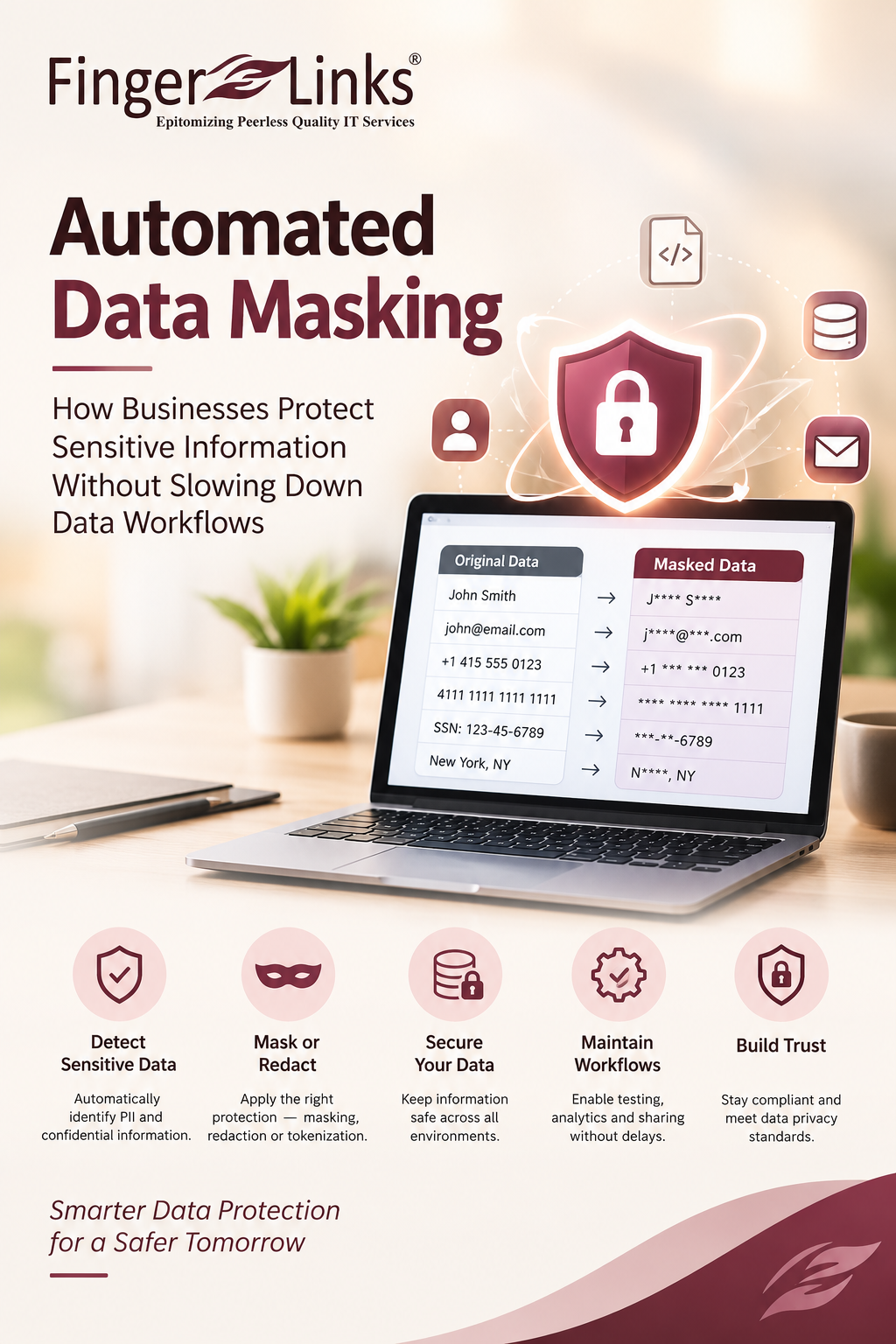
Data masking is the process of transforming sensitive information so that its original value is hidden or protected. For example, a customer's phone number could appear as +1 *** *** 0123, while an email address could be displayed as j****@***.com. The underlying data is protected, while the dataset can still retain the structure required for many business processes.
How Does Automated Data Masking Work?
An automated data masking process can identify sensitive fields and apply predefined protection rules without requiring employees to manually modify individual records.
A typical workflow can include:
Data Identification → Sensitive Data Detection → Masking Rules → Automated Transformation → Protected Dataset → Secure Use
Depending on the business requirement, different techniques can be applied, including masking, redaction, substitution, tokenization, or other privacy-preserving transformations.
Why Businesses Need Automated Data Masking
Manual protection of large datasets can be time-consuming and difficult to maintain consistently. Automation can help organizations apply standardized masking rules across large volumes of information.
Key advantages include:
- Protecting sensitive information: Reduce unnecessary exposure of confidential data.
- Supporting safer testing: Developers and testing teams can work with protected datasets.
- Improving data privacy: Sensitive fields can be automatically handled according to defined policies.
- Reducing manual effort: Automated rules eliminate repetitive data-protection tasks.
- Maintaining data usability: Masked datasets can retain useful structures for testing and analysis.
- Supporting secure data sharing: Protected datasets can be provided to appropriate teams without unnecessarily exposing original information.
- Scalability: Automated processes can handle growing datasets more efficiently.
Automated Data Masking in Different Business Environments
Automated masking can be useful across industries where sensitive information is regularly processed. Healthcare organizations may need to protect patient-related information, while financial organizations may handle account and transaction details. Businesses working with customer databases, employee records, insurance information, or administrative data can also use automated masking to reduce unnecessary exposure.
Automated Data Masking and Business Workflows
Data protection does not have to interrupt business operations. When masking is incorporated into automated data workflows, sensitive information can be identified and transformed as part of the existing process.
This can help businesses create a more controlled approach to handling information across development, testing, analytics, reporting, and data-sharing environments.
Building a More Secure Data Strategy
Automated data masking is one component of a broader data-protection strategy. Businesses should combine appropriate technical controls, access management, security practices, privacy policies, and organizational procedures according to their specific requirements.
As organizations continue to process larger volumes of sensitive information, automation can help make data protection more consistent, scalable, and manageable.
FingerLinks Infotech helps businesses with technology-enabled data and process solutions designed to support efficient and secure information handling. Automated data protection can help organizations make better use of their data while reducing unnecessary exposure of sensitive information.




.jpg)