Automated Data Profiling: How Businesses Automatically Understand the Structure, Quality, and Patterns of Their Data
- ⏰ September-17-2026 |
- ✍️ By Admin |
- 🏷️ In Data Automation
Businesses rely on data for reporting, analytics, customer management, financial operations, automation, and strategic planning. However, before data can be used effectively, organizations need to understand what the data actually contains.
Large datasets can include thousands or millions of records collected from different applications, databases, spreadsheets, customer systems, websites, and operational platforms. Reviewing such information manually can be time-consuming and may make it difficult to identify patterns or inconsistencies.
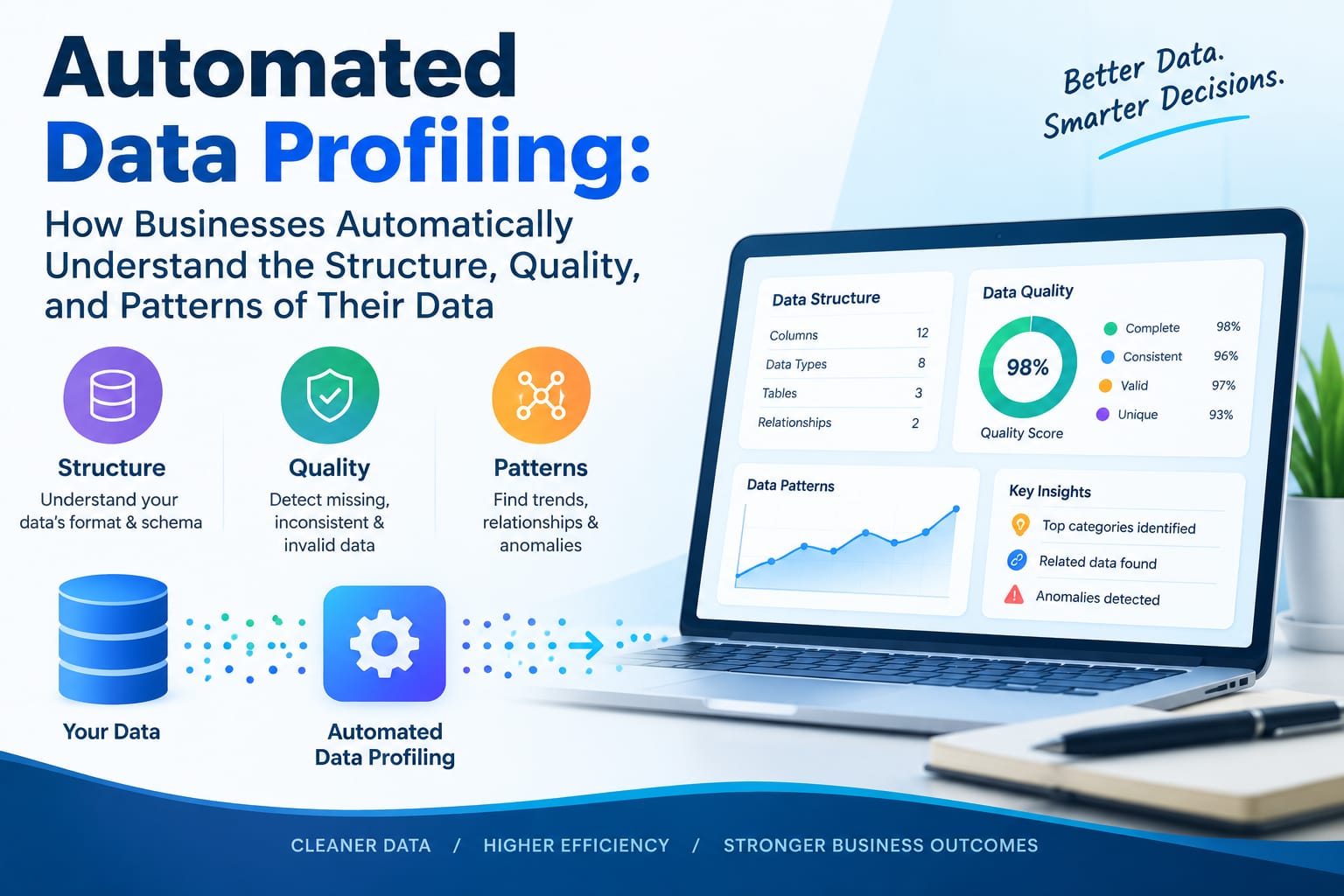
Automated data profiling provides a systematic way to examine datasets and generate useful information about their structure, content, completeness, and characteristics. Instead of manually reviewing every field and record, automated profiling tools analyze the data and produce a summary that helps teams understand what they are working with.
What Is Automated Data Profiling?
Automated data profiling is the process of using software or automated processes to examine a dataset and identify its important characteristics.
A profiling process can examine factors such as:
- Number of records and columns
- Data types and formats
- Missing values
- Unique values
- Duplicate values
- Value frequencies
- Minimum and maximum values
- Average and other statistical measures
- Common patterns
- Inconsistent formats
- Relationships between fields
- Potential anomalies
For example, a customer database may contain a field called Phone Number. Automated profiling could reveal that some records contain 10-digit numbers, others contain country codes, and some records are blank.
The purpose is not necessarily to correct the information immediately. Instead, profiling provides a clear picture of the dataset so organizations can determine what needs attention.
Why Do Businesses Need Data Profiling?
Modern organizations often collect data from multiple sources. Customer information may come from websites, CRM platforms, mobile applications, sales systems, and external databases.
As datasets grow, understanding their characteristics becomes increasingly difficult.
Manual inspection can create several challenges:
- Large volumes of data take longer to review.
- Important patterns can be overlooked.
- Different teams may interpret the same dataset differently.
- Repeated profiling consumes employee time.
- Changes in datasets may not be noticed quickly.
- Data preparation can become slower.
Automated profiling addresses these challenges by performing repetitive examination tasks consistently.
It can provide teams with an overview of a dataset without requiring them to manually inspect every record.
How Automated Data Profiling Works
The profiling process generally begins when a dataset is connected to an automated profiling system.
The system then examines the available fields and records and calculates relevant characteristics.
A typical workflow includes the following stages.
1. Data Collection
The system accesses data from sources such as databases, spreadsheets, applications, cloud platforms, or files.
2. Structure Analysis
The profiling process identifies tables, columns, fields, data types, and other structural characteristics.
3. Content Analysis
The system examines the values stored in individual fields. It can calculate frequencies, uniqueness, missing-value rates, and statistical characteristics.
4. Pattern Identification
Automated rules can identify common patterns in fields such as email addresses, telephone numbers, dates, postal codes, and identification numbers.
5. Quality Indicators
The system can summarize potential quality concerns, such as incomplete fields, unexpected values, duplicates, or inconsistent formats.
6. Profile Generation
The collected information is presented through reports, dashboards, summaries, or other outputs that allow teams to understand the dataset.
This automated process can be repeated whenever new datasets are introduced or existing datasets change.
Key Characteristics Identified Through Data Profiling
One of the main advantages of profiling is that it provides detailed information about individual fields.
Completeness
Completeness measures how much required information is actually present.
For example, if 92% of customer records contain an email address, the profile can highlight that approximately 8% of records have missing email information.
This helps teams identify fields that may require additional attention.
Uniqueness
Profiling can determine how many distinct values exist within a column.
For example, a customer ID should generally have a high level of uniqueness. If many records share the same identifier, the profile can highlight the pattern for further investigation.
Duplicate Patterns
Automated profiling can identify repeated records or repeated values.
For example, a customer database may contain multiple records with the same email address, telephone number, or combination of identifying fields.
Identifying these patterns can support subsequent data-cleaning activities.
Data Types
A profile can identify whether fields contain text, numbers, dates, Boolean values, or other data types.
This is particularly useful when datasets originate from different systems.
Frequency Distribution
Profiling can show how frequently specific values appear.
For example, a business may discover that one category represents 70% of records while several other categories appear only rarely.
These observations can help teams better understand the dataset.
Automated Data Profiling vs. Data Validation
Although these concepts are related, they serve different purposes.
Data profiling primarily focuses on understanding the characteristics of existing data.
Data validation checks whether data complies with predefined rules or requirements.
For example:
Profiling: “What percentage of customer records contain missing postal codes?”
Validation: “Every customer record must contain a valid postal code.”
Profiling therefore provides valuable information that can help organizations establish appropriate validation rules.
Applications of Automated Data Profiling
Automated profiling can be useful across many business activities.
Data Migration
Before moving information from one system to another, organizations need to understand the source dataset.
Profiling can reveal field structures, missing information, duplicates, unusual values, and format variations that may need to be addressed before migration.
Business Intelligence
Analytics teams depend on reliable and understandable datasets.
Profiling can help teams assess the characteristics of data before using it for dashboards, reporting, and analytical models.
Customer Data Management
Organizations can profile customer records to understand completeness, uniqueness, formats, and value distributions.
This can support subsequent data-quality improvement initiatives.
Healthcare Data
Healthcare organizations work with large volumes of structured and semi-structured information.
Automated profiling can help teams understand the characteristics of datasets before they are prepared for reporting, analytics, or system migration, subject to applicable privacy and regulatory requirements.
Financial Data
Financial organizations can use profiling to examine transaction datasets, account information, reporting data, and other structured records.
Profiling can help identify unusual distributions and incomplete fields that warrant further review.
Benefits of Automated Data Profiling
Automated data profiling offers several practical benefits.
Saves Time:
Automated systems can analyze large datasets much faster than manual inspection.
Improves Visibility:
Teams receive a structured overview of the dataset and its characteristics.
Supports Data Quality Initiatives:
Profiling helps identify areas that may require cleaning, standardization, or additional controls.
Enables Consistent Analysis:
Automated processes can apply the same profiling logic across multiple datasets.
Supports Better Data Preparation:
Organizations can understand their data before beginning migration, analytics, integration, or other data-related activities.
Scales With Data Volume:
Automated profiling can handle datasets that would be impractical to inspect manually.
Challenges to Consider
Although automated data profiling provides significant advantages, organizations should consider several factors when implementing it.
Large Data Volumes:
Very large datasets may require appropriate infrastructure and processing strategies.
Complex Data Structures:
Semi-structured and unstructured data may require specialized profiling techniques.
Sensitive Information:
Profiling processes must be designed carefully when datasets contain confidential or personally identifiable information.
Interpretation:
A profiling report identifies characteristics and potential concerns, but business teams may still need to determine what those findings mean and what action should follow.
Changing Data Sources:
Datasets can evolve as applications and business processes change. Profiling processes should therefore be incorporated into ongoing data-management practices.
How Businesses Can Make Data Profiling More Effective
Organizations can improve their profiling processes by establishing clear objectives before analyzing data.
They should determine:
- Which datasets need to be profiled
- Which fields are important
- Which characteristics should be measured
- How frequently profiling should occur
- Who will review profiling results
- How findings will be documented
- What actions should follow significant findings
It is also useful to maintain standardized profiling reports so teams can compare datasets consistently.
For recurring business processes, profiling can become part of a broader automated data-management workflow.
The Future of Automated Data Profiling
As businesses continue to generate information from more applications and digital channels, automated approaches to understanding data are becoming increasingly valuable.
Future profiling systems can combine statistical analysis, machine learning, metadata, and intelligent pattern recognition to provide deeper insights into datasets.
Instead of simply reporting that a field contains inconsistent values, advanced systems may identify recurring patterns and provide contextual information that helps data teams investigate the issue.
Integration with data-management platforms can also allow profiling results to become part of broader data-quality and governance processes.
Conclusion
Understanding data is an important step before organizations use it for business intelligence, migration, reporting, automation, or decision-making. Automated data profiling provides businesses with a practical way to examine datasets systematically and identify their structure, patterns, completeness, uniqueness, and potential inconsistencies.
By reducing repetitive manual inspection, automated profiling can save time and provide teams with greater visibility into their data. More importantly, it gives organizations an informed starting point for subsequent data-quality and data-management activities.
As data volumes continue to increase, automated profiling can become an important component of a modern data-management strategy—helping businesses understand their information before putting it to work.