Automated Data Lineage: How Businesses Track Where Data Comes From, Changes, and Goes?
- ⏰ September-09-2026 |
- ✍️ By Admin |
- 🏷️ In Data Automation
Modern businesses rely on data that moves through multiple systems every day. Customer information may begin in a website form, move into a CRM, pass through a data-processing system, enter a reporting platform, and eventually appear in a business dashboard.
As data moves through these systems, it may be cleaned, transformed, combined, filtered, or enriched. When something goes wrong, businesses need to know where the data came from, what happened to it, and where it is being used.
This is where automated data lineage becomes valuable.
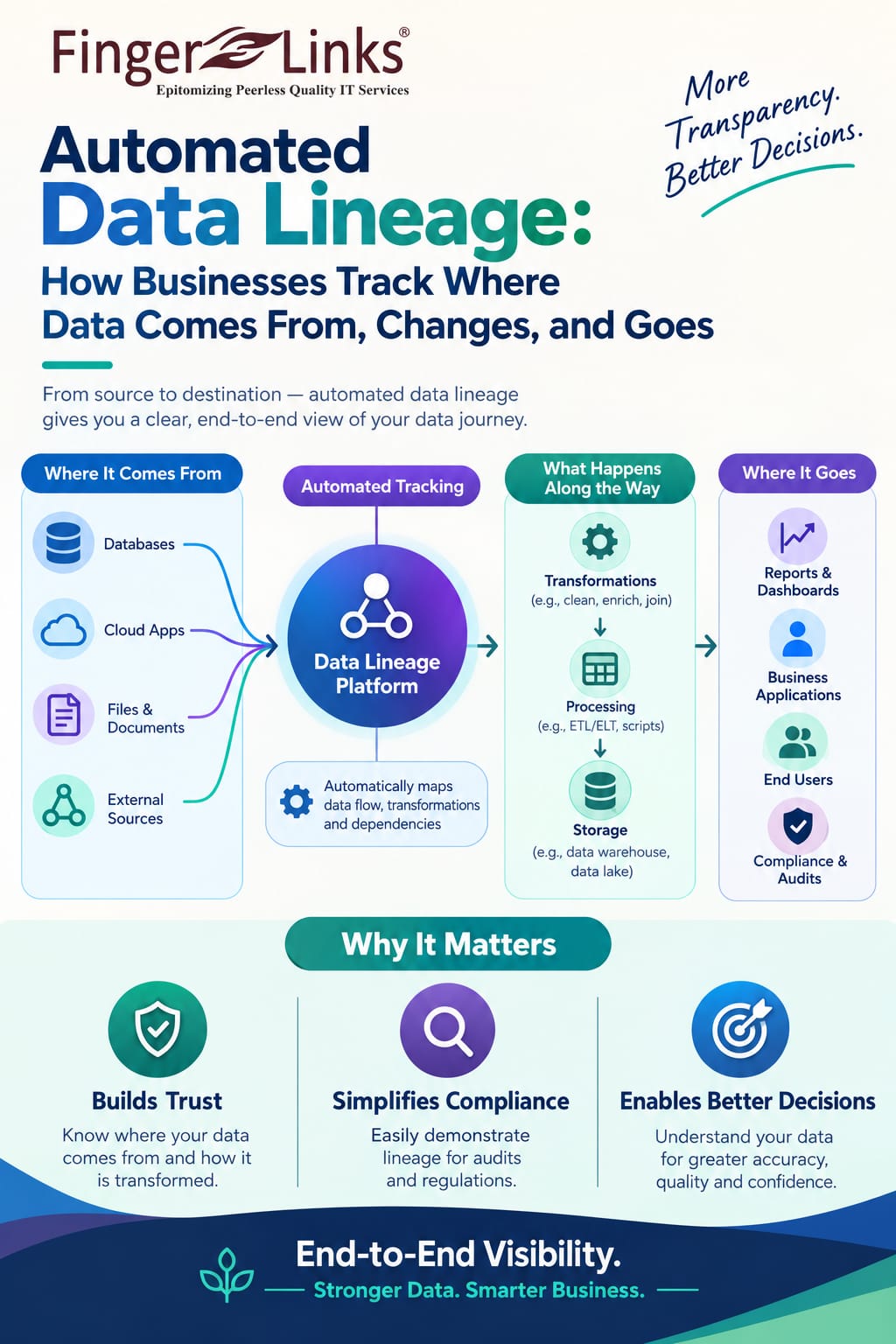
Automated data lineage creates a traceable view of the journey data takes throughout an organization. Instead of manually documenting every connection and transformation, automation can identify data sources, follow data movement, record transformations, and maintain relationships between datasets and business outputs.
What Is Data Lineage?
Data lineage is the process of tracking the lifecycle of data from its original source to its final destination.
A simple data journey might look like:
Data Source → Data Collection → Processing → Transformation → Storage → Reporting → Business Decision
For example, a company may collect customer information through an online registration form. The information could then be transferred to a CRM system, cleaned to remove incomplete records, combined with sales information, stored in a database, and finally used in a customer performance report.
Data lineage helps businesses understand each stage of this journey.
It can answer important questions such as:
- Where did this data originate?
- Which systems have processed it?
- What transformations were applied?
- Where is the data currently stored?
- Which reports depend on it?
- Which business processes use it?
- What could be affected if the source data changes?
Why Automate Data Lineage?
Manually documenting data flows becomes increasingly difficult as businesses add more applications, databases, APIs, spreadsheets, and cloud platforms.
A single business environment may contain dozens or hundreds of data connections. Keeping documentation updated manually can consume significant time and may leave gaps when systems or workflows change.
Automated data lineage can continuously map these relationships and reduce the amount of manual documentation required.
Automation can help identify:
Data Sources:
Databases, applications, spreadsheets, APIs, cloud platforms, and other systems where information originates.
Data Movement:
How information travels between different applications, databases, pipelines, and business systems.
Data Transformations:
Changes made to information during processing, such as filtering, formatting, calculations, aggregation, or enrichment.
Data Destinations:
Reports, dashboards, databases, applications, and other locations where processed information is ultimately used.
This creates a clearer picture of the organization's overall data environment.
How Automated Data Lineage Works
An automated data lineage process can be designed around several stages.
1. Identify Data Sources
The first step is identifying the systems that generate or store business information.
These may include:
- CRM platforms
- ERP systems
- Databases
- Cloud applications
- Spreadsheets
- Websites
- APIs
- Data warehouses
- Internal business applications
Automation can collect metadata from these sources and establish relationships between datasets.
2. Track Data Movement
Once data sources are identified, automated lineage tools can track how information moves between systems.
For example:
Website Form → CRM → Database → Data Warehouse → Dashboard
Instead of viewing each system separately, businesses can see how they are connected as part of a larger data journey.
3. Record Data Transformations
Data rarely moves from one system to another without modification.
It may be:
- Cleaned
- Filtered
- Standardized
- Converted
- Combined
- Aggregated
- Enriched
- Reorganized
Automated lineage can document these transformations, making it easier to understand how the original information becomes the final dataset.
4. Connect Data to Business Outputs
One of the most useful aspects of data lineage is understanding how datasets support business outputs.
For example, a sales dashboard may depend on information from several databases and transformation processes.
If one source changes, lineage information can help identify which reports, dashboards, applications, or processes may be affected.
5. Maintain an Updated Data Map
Business systems change continuously. New applications may be added, databases may be modified, and workflows may be redesigned.
Automated lineage can help maintain a more current view of these relationships instead of relying entirely on outdated documentation.
Benefits of Automated Data Lineage
Better Data Transparency
Businesses can gain a clearer understanding of where their information comes from and how it travels across systems.
This is especially useful when data is distributed across multiple departments and platforms.
Faster Troubleshooting
When a report contains an unexpected value, finding the source of the problem can otherwise require checking multiple systems.
Data lineage provides a path that teams can follow backward through the data flow to identify where an issue may have originated.
Improved Impact Analysis
Suppose a database field is renamed or a source system changes its data structure.
Before making the change, businesses need to understand what could be affected.
Automated lineage can help identify downstream dependencies, allowing teams to assess potential impacts before changes are implemented.
Stronger Data Governance
Data governance depends on knowing what data exists, where it comes from, how it is used, and who works with it.
Data lineage complements governance efforts by providing visibility into data movement and relationships. FingerLinks' recent governance article similarly emphasizes the importance of knowing where business data comes from and how it is used.
Reduced Documentation Work
Maintaining data-flow diagrams manually can become a repetitive task.
Automation can reduce this workload by continuously collecting metadata and updating lineage information as the data environment evolves.
Better Collaboration
Data engineers, analysts, IT teams, compliance teams, and business users may all need different information about the same datasets.
A clear lineage view provides a shared understanding of how data moves through the organization.
Automated Data Lineage vs. Data Integration
Data integration and data lineage are related, but they serve different purposes.
Data integration focuses on connecting systems and moving information between them.
Data lineage focuses on understanding and documenting the journey of that information.
For example:
Integration:
CRM → ERP → Data Warehouse
Lineage:
Customer data originated in the CRM, was transferred to the ERP, transformed during processing, stored in the warehouse, and later used in a sales report.
Therefore, lineage can provide visibility into the data flows created through integration.
Automated Data Lineage in Different Industries
Automated data lineage can be useful across many industries.
Financial Services
Financial organizations can track how transaction and customer information moves through processing systems and reporting platforms.
Healthcare
Healthcare organizations can use lineage to understand how information moves between applications, databases, reporting systems, and analytics environments.
Retail
Retail businesses can track customer, product, sales, and inventory information across multiple systems.
Insurance
Insurance companies can follow policy, claims, customer, and financial information through different processing stages.
Manufacturing
Manufacturers can track operational and production data from collection systems through analytical and reporting platforms.
BPO and Business Services
BPO organizations handling information for multiple clients can use lineage to understand how data moves through processing workflows and reporting systems.
The Future of Automated Data Lineage
As businesses adopt more cloud applications, APIs, analytics platforms, and automated data workflows, understanding data relationships becomes increasingly important.
Automation can make lineage more dynamic by continuously observing data environments rather than depending solely on manually maintained diagrams.
Combined with data governance, monitoring, integration, and data-quality processes, automated lineage can become an important part of modern data management.
For FingerLinks, this topic also complements the company's existing data automation content without simply repeating its recent articles on automated workflows, monitoring, integration, or governance.
Conclusion
Businesses cannot effectively manage data if they cannot understand its journey.
Automated data lineage provides visibility into where data originates, how it changes, where it travels, and which business processes depend on it.
By reducing manual documentation, improving traceability, supporting impact analysis, and helping teams troubleshoot data issues, automated lineage can make complex data environments easier to understand and manage.
As organizations continue to automate their data processes, knowing what happens to data after it enters the system can be just as important as collecting and processing the data itself.
Automated data lineage turns complex data journeys into a clearer, traceable map—helping businesses manage information with greater confidence and control.