Beyond Bounding Boxes: How Image Segmentation Makes AI See More Precisely
- ⏰ August-19-2026 |
- ✍️ By Admin |
- 🏷️ In Data Automation
Artificial intelligence is becoming increasingly capable of understanding images, videos, and real-world environments. Behind many of these computer vision systems is data annotation, where images are carefully labeled to help AI models recognize and understand different objects. While bounding box annotation is widely used to identify objects, many advanced AI applications require much greater precision. This is where image segmentation annotation becomes important.
What Is Image Segmentation Annotation?
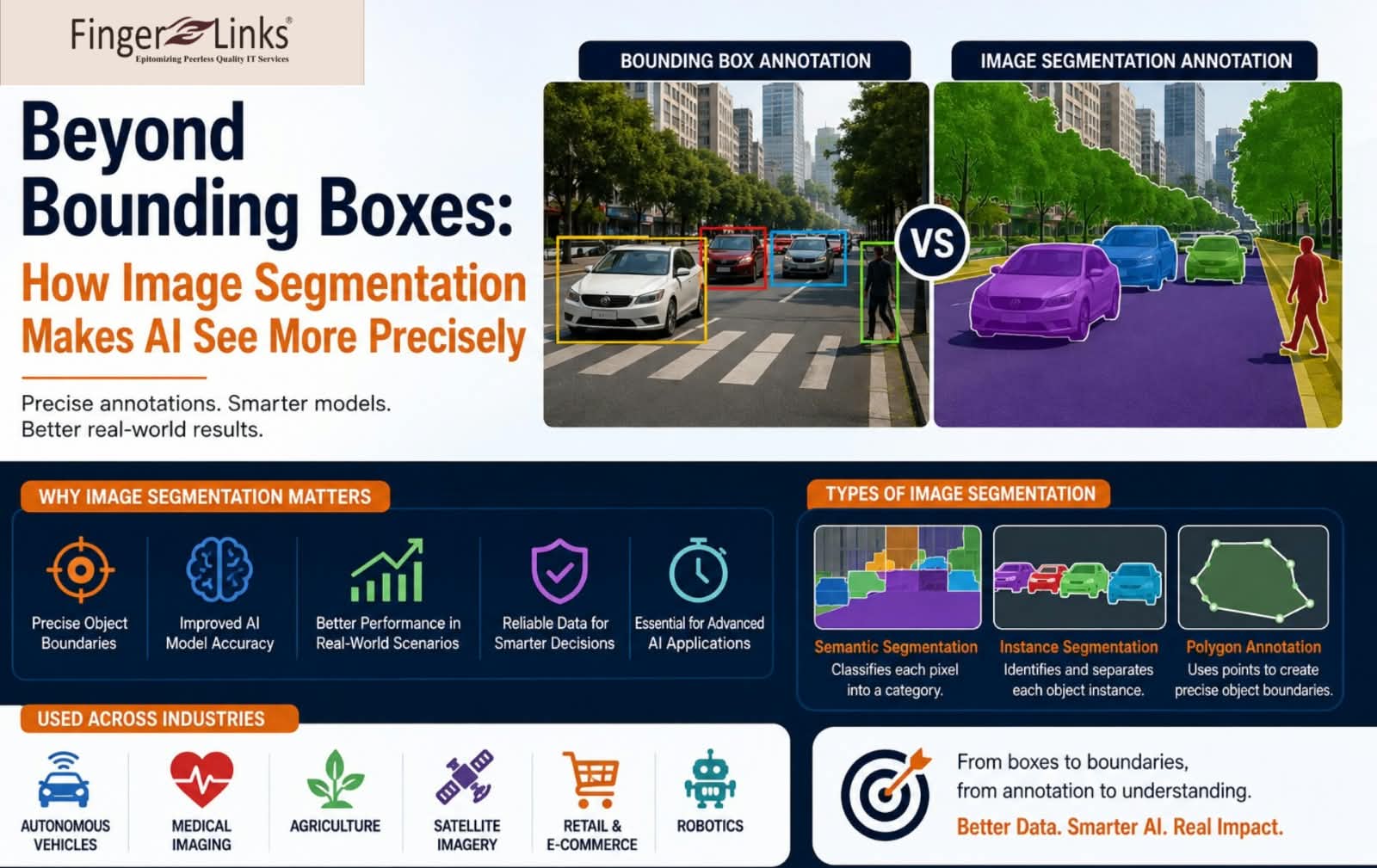
Image segmentation annotation is a technique that identifies the precise pixels or boundaries belonging to specific objects or regions within an image. Instead of simply placing a rectangular box around an object, segmentation follows the actual shape of the object.
For example, a bounding box can identify a car in a street image, but it also includes some of the surrounding road and background. Image segmentation can outline the exact area occupied by the car, providing AI models with more detailed information.
Why Is Image Segmentation Important?
AI models learn from the quality of their training data. When an application requires an accurate understanding of object boundaries, basic rectangular annotations may not provide enough detail.
Precise segmentation helps AI models distinguish between objects that are close together, understand complex shapes, and identify the exact regions that belong to particular categories.
This can be especially valuable in situations where even small differences can affect the model's output.
Types of Image Segmentation
There are several approaches to image segmentation:
Semantic Segmentation:
Every pixel in an image is assigned to a particular category. For example, pixels can be labeled as road, vehicle, building, tree, or pedestrian.
Instance Segmentation:
This approach identifies individual objects separately, even when multiple objects belong to the same category. For example, three cars in an image can be separately identified and segmented.
Polygon Annotation:
Annotators use multiple points to create a detailed outline around an object. This is useful for objects with irregular or complex shapes.
Where Is Image Segmentation Used?
Image segmentation plays an important role in many industries and AI applications.
Autonomous Vehicles: Self-driving systems need to distinguish vehicles, pedestrians, roads, traffic signs, and other objects accurately.
Medical Imaging: Segmentation can help identify and outline specific areas in medical images for AI-assisted analysis.
Agriculture: AI systems can use segmented images to identify crops, weeds, plant diseases, and other areas of interest.
Satellite Imaging: Precise segmentation can help identify buildings, roads, agricultural areas, water bodies, and changes in geographical regions.
Retail: Computer vision systems can identify products and their precise locations for inventory management and automated retail applications.
The Importance of Quality Annotation
Accurate image segmentation requires careful annotation. Poorly defined boundaries, inconsistent labeling, or incorrectly classified objects can affect the quality of AI training datasets.
Professional annotation processes generally involve clear guidelines, trained annotators, quality checks, and consistency reviews. These steps help ensure that the final dataset provides reliable information for model training.
Image Segmentation vs. Bounding Boxes
Bounding boxes remain highly useful when identifying the general location of objects is sufficient. However, segmentation provides a much more detailed representation.
Bounding Box: Identifies an object's approximate location using a rectangle.
Image Segmentation: Identifies the object's precise shape and boundaries.
Therefore, the appropriate annotation method depends on the requirements of the AI model and the intended application.
Conclusion
As computer vision continues to develop, AI systems need increasingly detailed training data to perform accurately in real-world environments. Image segmentation annotation takes image labeling beyond simple bounding boxes by providing precise information about object boundaries and regions.
For businesses developing computer vision models, investing in high-quality segmentation data can help create more reliable AI systems across industries such as healthcare, autonomous transportation, agriculture, retail, and geospatial analysis.
Better annotation creates better training data—and better training data helps AI see the world more precisely.