Dubbing Script Adaptation: How to Create Natural and Culturally Relevant Dialogue
- ⏰ September-29-2026 |
- ✍️ By Admin |
- 🏷️ In Dubbing
When a video, film, advertisement, training program, or e-learning course is translated into another language, simply converting the original words is rarely enough. The translated dialogue must sound natural when spoken, fit the available time, reflect the character's personality, and work with what viewers see on screen.
This is where dubbing script adaptation becomes important.
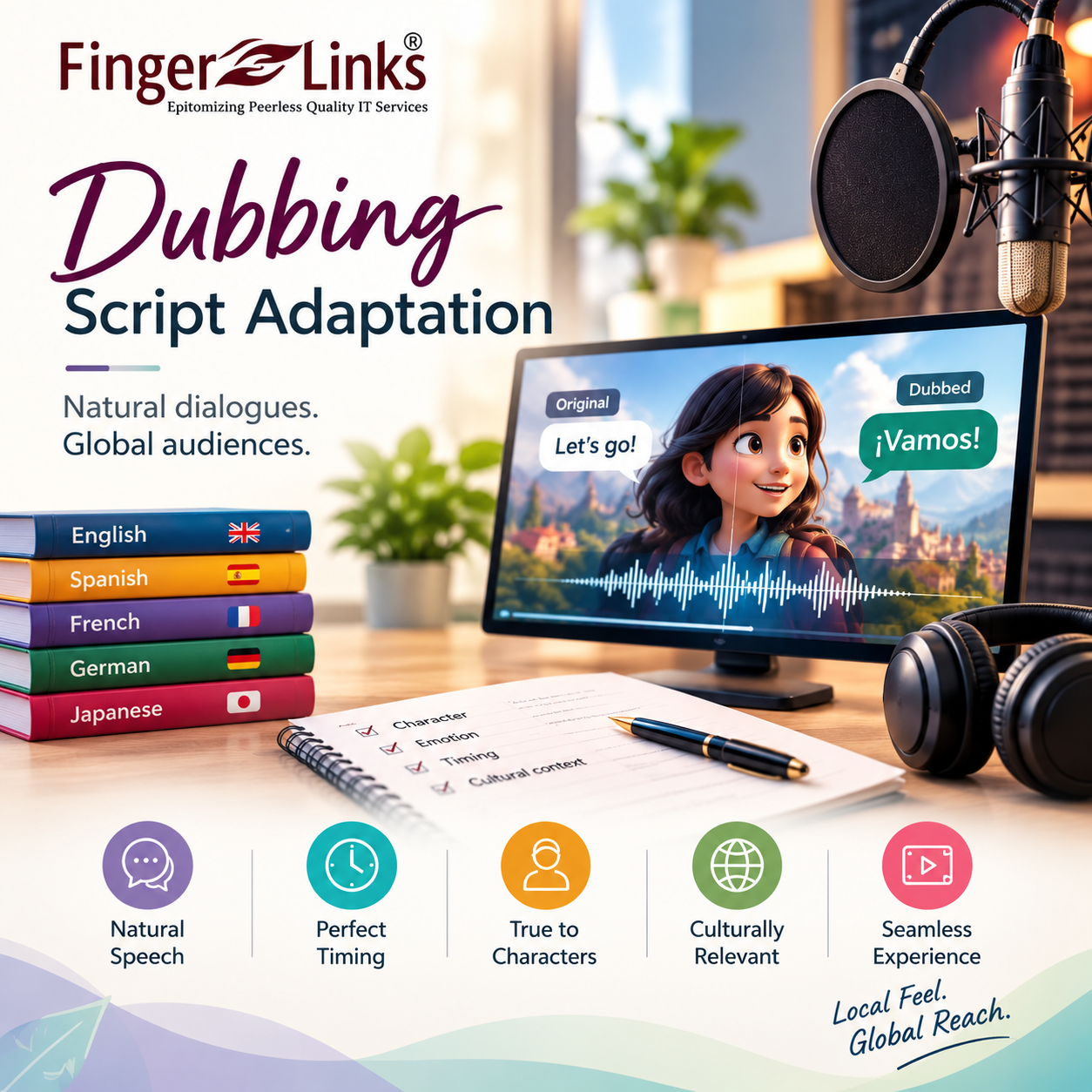
Dubbing script adaptation is the process of transforming translated dialogue into speech that can actually be performed within a scene. Unlike conventional translation, it considers timing, pronunciation, characterisation, emotion, cultural references, and synchronization with the original performance.
A well-adapted script can make translated content feel much more natural to its target audience. Research on professional dubbing has identified factors such as natural-sounding language, synchronization, character allocation, and script functionality as important areas affecting dubbing quality.
What Is Dubbing Script Adaptation?
Dubbing script adaptation takes a translated script and reshapes it for spoken performance.
For example, a literal translation may communicate the correct meaning but sound unnatural when spoken by a character. The adapted version may use different wording while preserving the original message, emotion, and intent.
The process considers questions such as:
- Does the dialogue fit the duration of the original speech?
- Can the voice actor say the line naturally?
- Does the dialogue suit the character?
- Does it work with the character's mouth movements?
- Are cultural references understandable to the target audience?
- Does the emotional tone remain intact?
This distinction is important because translation communicates meaning, while adaptation makes that meaning work within the audiovisual scene.
Why Word-for-Word Translation Is Not Enough
A direct translation may be grammatically correct but still unsuitable for dubbing.
Consider a short English dialogue:
“You have got to be kidding me!”
A literal translation may preserve the individual words but fail to communicate the same surprise, frustration, or disbelief in another language.
An adapter may instead select a natural expression commonly used by speakers of the target language. The exact wording can change while the character's intention remains the same.
This approach is especially important for:
- Movies and television programs
- OTT content
- YouTube videos
- Advertising campaigns
- Corporate videos
- E-learning courses
- Product demonstrations
- Training content
- Social media videos
The objective is not to change the original message. It is to make the message sound as though it was naturally written for the target audience.
1. Timing and Dialogue Length
One of the biggest differences between ordinary translation and dubbing adaptation is timing.
A character may have only a few seconds to speak a particular line. A translated sentence that takes considerably longer to say can create an obvious mismatch between the audio and the video.
The adapter therefore considers:
- Duration of the original dialogue
- Number of words
- Syllable count
- Speaking speed
- Pauses
- Scene transitions
- Character movement
The adapted line must fit naturally into the available window.
Dubbing guidance commonly identifies duration, mouth movement, and natural delivery as interconnected constraints when adapting dialogue.
Why timing matters
Imagine a character finishing a sentence while their mouth continues moving for another second. The audience may immediately notice the mismatch.
Good adaptation reduces this problem by creating dialogue that can be delivered within the scene's intended timing.
2. Lip-Sync and Phonetic Considerations
Dubbing is also influenced by what happens visually on screen.
When a character is shown speaking in a close-up, the audience can clearly see the movement of the lips. Certain sounds and mouth positions can therefore become important when adapting the translated dialogue.
For example, sounds involving the lips, such as M, B, and P, can be particularly noticeable during close-up shots.
Professional dubbing adaptation may therefore consider:
- Lip movements
- Open and closed mouth positions
- Key consonants
- Vowel sounds
- Syllable patterns
- Beginning and ending sounds
The aim is not necessarily to reproduce every original sound, but to create a spoken line that works convincingly with the visual performance. The Association of Translation Companies' audiovisual guidance describes phonetic synchrony and isochrony as key aspects of dubbing adaptation.
3. Preserving Character Personality
Every character has a distinct way of speaking.
A teenager, lawyer, teacher, executive, child, comedian, or elderly character should not necessarily sound as though the same person wrote every line.
Dubbing script adaptation takes characterisation into account.
The adapter may consider:
- Age
- Profession
- Personality
- Social background
- Relationship with other characters
- Formality
- Emotional state
- Speaking habits
For example, a corporate executive may use formal language, while a group of friends may use informal expressions.
A technically accurate translation that ignores these differences can make characters feel less authentic.
4. Maintaining Emotion and Tone
Words are only one part of dialogue. The way something is expressed can be equally important.
A character could be:
- Angry
- Excited
- Frightened
- Sarcastic
- Humorous
- Emotional
- Confused
- Calm
- Suspicious
The adapted dialogue should allow the voice actor to reproduce the intended emotion.
A sentence that looks perfectly acceptable on paper may become awkward when spoken. Reading the script aloud is therefore useful during adaptation because it helps identify unnatural expressions, difficult phrasing, and lines that do not fit the character's performance.
Professional research on dubbing adaptation has specifically highlighted natural-sounding language as an important quality factor.
5. Cultural Adaptation
Language and culture are closely connected.
Films, advertisements, entertainment programs, and online videos often contain:
- Idioms
- Jokes
- Slang
- Cultural references
- Food references
- Sports references
- Local expressions
- Social conventions
- Wordplay
A direct translation may not make sense to audiences in another region.
For example, a joke based on a word with two meanings in English may lose its humour when translated literally. The adapter may need to create an equivalent expression that produces a similar effect for the target audience.
This is sometimes referred to as transcreation or cultural localization.
The goal is to preserve the intended effect rather than mechanically reproduce the original words. Dubbing resources similarly identify cultural references and idiomatic expressions as areas requiring adaptation.
6. Consistency Across Episodes and Projects
For series, training programs, and large video libraries, consistency becomes particularly important.
Character names, technical terminology, recurring expressions, titles, locations, and product names should remain consistent throughout the content.
A terminology or character glossary can help maintain consistency.
For example, if a character's name is adapted one way in Episode 1 and differently in Episode 5, viewers may become confused.
A structured workflow can therefore include:
- Source script review
- Translation
- Dubbing adaptation
- Terminology verification
- Timing and synchronization review
- Voice recording
- Audio-video quality review
Maintaining terminology and consistency across episodes is also identified as part of professional dubbing workflows.
7. Human Expertise and AI-Assisted Dubbing
AI technologies are increasingly being used in translation, voice generation, and dubbing workflows. They can assist with repetitive tasks and help accelerate content localization.
However, script adaptation involves context and creative judgment.
A human reviewer can identify issues such as:
- An expression that sounds unnatural
- A joke that does not work in the target language
- A character speaking too formally
- A translation that changes the intended meaning
- A line that is difficult to perform
- An inappropriate cultural reference
- Inconsistent terminology
This does not mean AI and human workflows need to be separate. AI can assist with initial translation or content processing, while experienced language professionals can review and refine the adapted script.
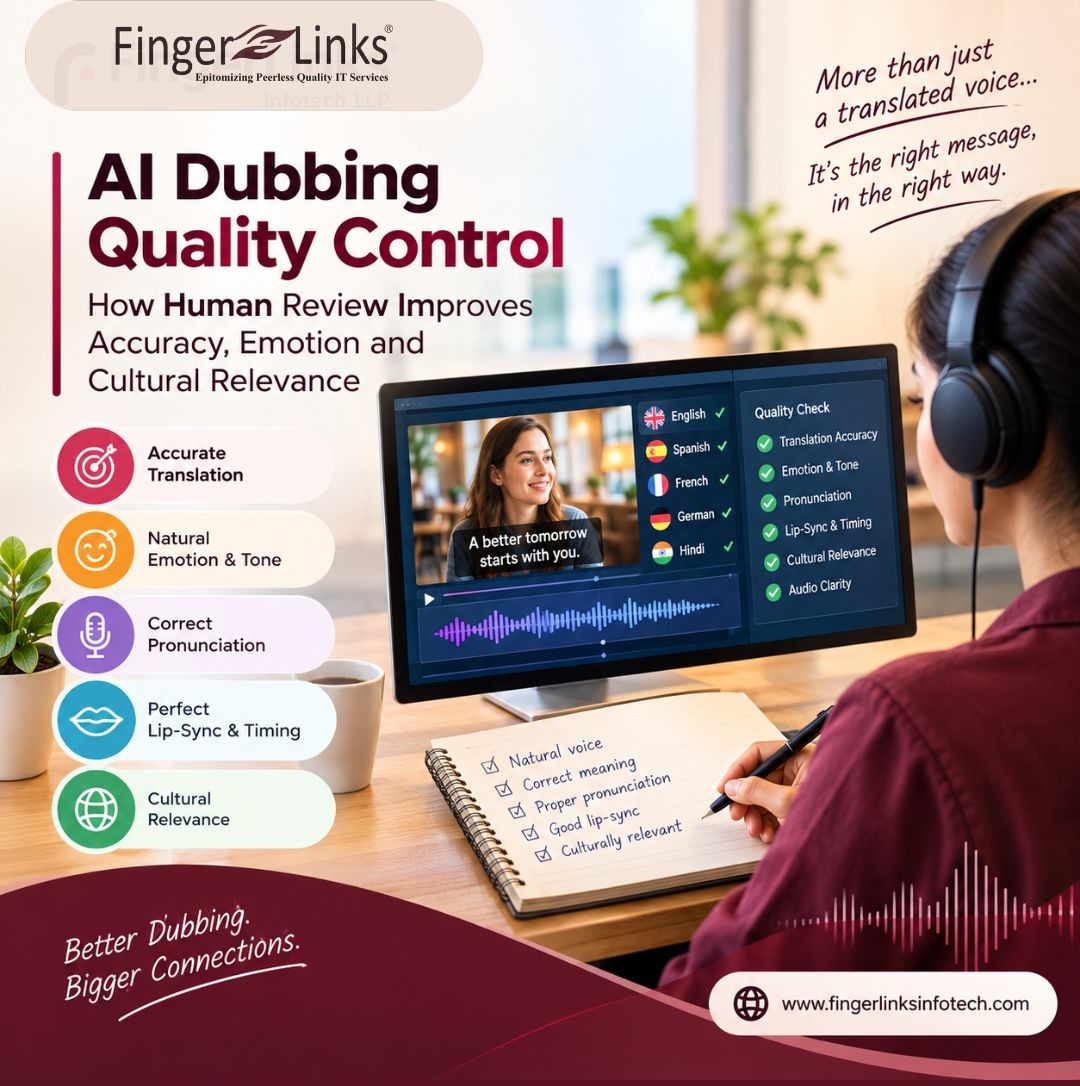
FingerLinks' latest Dubbing article similarly addresses the role of human review in AI-powered dubbing quality, including accuracy, emotional delivery, pronunciation, synchronization, and cultural relevance.
A Practical Dubbing Script Adaptation Workflow
A structured adaptation process can help maintain quality from the original content through to the final dubbed version.
Step 1: Review the Source
Understand the video, characters, dialogue, scene context, and intended audience.
Step 2: Translate the Dialogue
Create an accurate translation while preserving the original meaning and context.
Step 3: Adapt for Speech
Rewrite sentences so they sound natural when spoken in the target language.
Step 4: Check Timing
Adjust the dialogue to fit the duration available in each scene.
Step 5: Review Synchronization
Check whether the adapted wording works with visible mouth movements and character actions.
Step 6: Check Cultural Relevance
Adapt idioms, jokes, references, and expressions where a literal translation would not work.
Step 7: Review Character Voice
Ensure every line matches the character's personality, age, role, and emotional state.
Step 8: Perform a Final Linguistic Review
Check grammar, terminology, pronunciation guidance, consistency, and overall naturalness before recording.
Why Dubbing Script Adaptation Matters
A successful dubbed production should feel natural rather than translated.
When dialogue is properly adapted, audiences can focus on the story, information, characters, or message instead of noticing awkward wording or synchronization problems.
For businesses and content creators, effective dubbing can help make multilingual content more accessible to audiences across different markets. For entertainment producers, it can help preserve character personality and emotional impact. For corporate and e-learning content, natural spoken language can make instructional material easier to follow.
Final Thoughts
Dubbing script adaptation is much more than translating dialogue from one language into another. It combines linguistic accuracy with timing, synchronization, characterisation, emotion, and cultural relevance.
A strong adaptation preserves the original message while making the dialogue sound natural for the target audience. With a structured workflow combining translation, adaptation, linguistic review, and audiovisual checks, businesses and content producers can create multilingual videos that communicate effectively across languages.
For organizations working with multilingual video content, professional dubbing and localization support can help transform translated dialogue into a polished spoken experience that fits the content, audience, and intended purpose.