One Record, Different Results: Solving Business Data Mismatches Through Automation
- ⏰ November-27-2026 |
- ✍️ By Admin |
- 🏷️ In Data Automation
In today's digitally connected business environment, organizations depend on multiple software applications, databases, spreadsheets, and cloud platforms to manage their daily operations. Customer information, financial transactions, inventory records, employee details, insurance data, and operational reports are frequently stored and processed across different systems. While these platforms help businesses improve productivity and manage information efficiently, maintaining consistency between them can become a significant challenge. The same record may contain different values depending on the system in which it is accessed, creating discrepancies that can affect reporting, workflow efficiency, customer service, and decision-making.
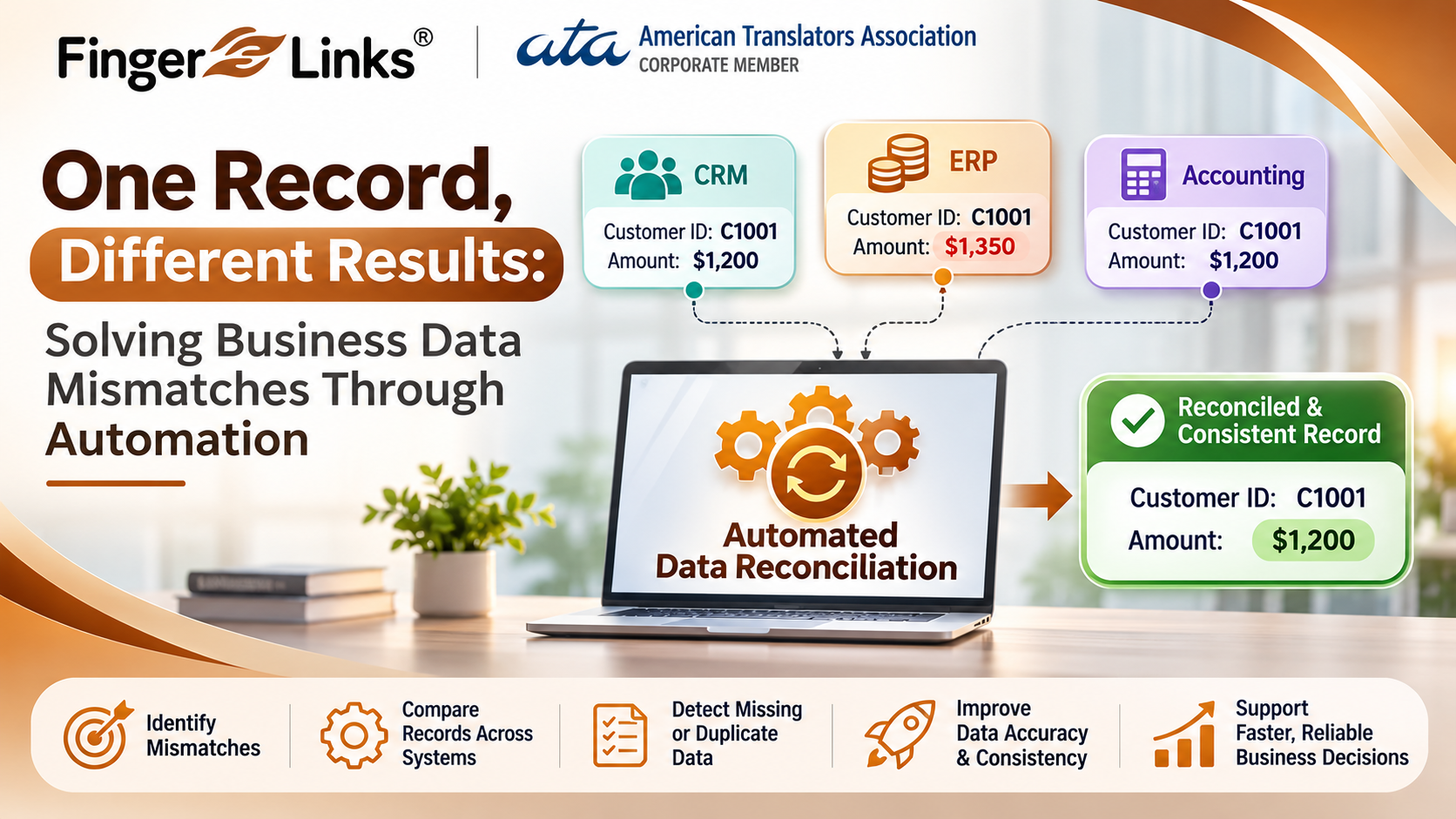
Data mismatches are not always caused by major system failures. Small inconsistencies can develop gradually through manual data entry, incomplete updates, duplicate records, differences in formatting, delayed synchronization, incorrect calculations, or changes made in one system but not reflected in another. For example, a customer’s contact information may be updated in a CRM platform but remain outdated in a billing database. A financial transaction may be recorded differently in an accounting system and a payment processing platform. Inventory quantities may not match between a warehouse management system and an e-commerce application. Although these discrepancies may appear minor individually, they can accumulate over time and create operational complications.
Traditional data reconciliation often involves employees manually comparing records, reviewing spreadsheets, checking transaction references, and identifying differences between datasets. This process can become time-consuming and difficult to manage when businesses handle large volumes of information. Manual comparison also increases the possibility of overlooking discrepancies, incorrectly identifying matching records, or introducing additional errors during corrections. As the number of systems and data sources grows, businesses require a more reliable and scalable approach to maintaining data consistency.
Automated data reconciliation provides a structured solution by using technology to compare information across multiple systems, identify discrepancies, and highlight records that require attention. Automated reconciliation workflows can process large datasets, apply predefined matching rules, compare relevant fields, detect missing information, identify duplicate entries, and flag conflicting values. By replacing repetitive manual comparisons with automated processes, businesses can improve the speed, consistency, and accuracy of reconciliation activities.
Understanding Automated Data Reconciliation
Automated data reconciliation is the process of verifying that information stored or processed across different systems is consistent, accurate, and aligned. It involves comparing datasets using predefined rules, identifiers, reference values, transaction details, and other relevant criteria. The objective is not simply to identify differences, but to determine which records match, which records contain discrepancies, and which situations require further investigation.
Reconciliation systems may use exact matching to compare unique identifiers, invoice numbers, transaction references, account IDs, or other fields that should remain consistent. They can also apply flexible matching techniques when information is not identical but may still represent the same record. For instance, variations in spelling, formatting, abbreviations, dates, or numerical values may require more advanced comparison logic.
Depending on business requirements, automated reconciliation can operate at different levels. Some workflows compare individual fields within records, while others compare entire transactions, account balances, inventory quantities, financial totals, or datasets across multiple platforms. The reconciliation rules can be customized according to the nature of the information, the acceptable tolerance levels, and the organization's operational procedures.
Why Data Mismatches Occur Across Business Systems
Data discrepancies can originate from several sources, particularly when businesses rely on interconnected systems that process information independently.
Manual data entry is one of the most common causes. Employees may enter incorrect numbers, misspell names, select the wrong reference number, or unintentionally create duplicate records. Differences in data formats can also create inconsistencies, such as dates stored in different formats, telephone numbers containing different country codes, currency values represented differently, or names recorded with varying punctuation and spacing.
System synchronization problems can create another challenge. When information is updated in one application, the changes may not immediately appear in another system due to integration delays, failed transfers, incomplete processing, or connectivity issues. In some situations, one system may process a transaction successfully while another fails to receive the corresponding update.
Business processes may also contribute to discrepancies. Different departments might maintain separate versions of the same information, apply different validation rules, or use different procedures for updating records. Over time, these differences can result in conflicting information across platforms.
Without a systematic reconciliation process, organizations may struggle to identify where the inconsistency originated, which version of the information is correct, and what action should be taken to resolve it.
How Automation Identifies and Resolves Discrepancies
Automated reconciliation begins by collecting information from the relevant data sources. Depending on the business environment, records may be extracted from databases, spreadsheets, APIs, cloud applications, ERP platforms, CRM systems, accounting software, or other operational tools.
Once the information is collected, the automation process organizes the datasets into a consistent structure so that records can be compared effectively. Data normalization may be applied to standardize dates, text formats, numerical values, identifiers, and other fields. This helps prevent unnecessary mismatches caused by differences in presentation rather than actual data discrepancies.
The system then applies reconciliation rules to identify corresponding records and compare relevant values. Matching may be based on unique identifiers, multiple field combinations, transaction references, customer details, dates, amounts, or predefined business logic.
Records can then be categorized into different outcomes:
-
Matched records: Information is consistent across the compared systems.
-
Mismatched records: Corresponding records exist, but one or more values differ.
-
Missing records: Information appears in one system but cannot be located in another.
-
Duplicate records: Multiple entries may represent the same transaction, customer, or business activity.
-
Uncertain matches: Records appear similar but require additional verification before being treated as identical.
The automation can generate exception reports highlighting discrepancies and their associated details. These reports may include the original values, comparison results, source systems, discrepancy categories, and recommended next steps. Workflows can then route unresolved issues to the relevant employees or departments for review.
This structured process reduces the need to manually search through large datasets and helps teams focus their attention on records that genuinely require investigation.
The Role of Intelligent Matching in Reconciliation
Not all records can be matched through exact comparisons. Business information may contain minor variations that make straightforward matching difficult. A customer name may be entered differently in two systems, an address may contain abbreviations, or a transaction reference may include additional characters.
Intelligent matching techniques can help identify records that are likely to correspond even when their values are not identical. Depending on the implementation, automated reconciliation may use similarity-based matching, configurable rules, weighted comparison methods, or AI-assisted approaches to evaluate multiple data fields together.
For example, two customer records may contain similar names, matching telephone numbers, and identical account references despite slight differences in formatting. A matching process can evaluate these characteristics collectively rather than relying on a single field.
However, intelligent matching should be implemented with appropriate safeguards. High-confidence matches may be processed automatically according to approved rules, while uncertain matches should be flagged for human verification. This prevents automation from incorrectly merging records or modifying sensitive business information.
Combining rule-based reconciliation with intelligent matching and human review can provide businesses with a balanced approach to speed, accuracy, and accountability.
Industry Applications of Automated Data Reconciliation
Automated reconciliation can support different business operations depending on the types of information being managed.
Finance and Accounting
Financial departments can compare invoices, payment records, bank transactions, ledger entries, and account balances across multiple systems. Automation helps identify missing transactions, duplicate payments, incorrect amounts, and inconsistencies between financial records. This can simplify reconciliation activities and improve the reliability of financial reporting.
Insurance Operations
Insurance organizations may maintain policyholder information, premium records, claims data, payment details, and customer information across different platforms. Automated reconciliation can compare these records, identify missing or conflicting details, and help ensure that information remains consistent throughout the processing workflow.
Retail and E-Commerce
Retail businesses frequently manage inventory, product listings, orders, sales transactions, returns, and warehouse records across multiple platforms. Automated reconciliation helps identify differences in stock quantities, order statuses, product information, and transaction records. This supports better inventory management and reduces operational confusion.
Logistics and Supply Chain
Logistics operations rely on shipment details, tracking records, delivery information, warehouse updates, and supplier data. Reconciliation automation can compare information across systems, identify incomplete shipment records, highlight conflicting delivery statuses, and improve visibility into supply chain operations.
Business Services and Customer Management
Organizations providing services to customers may maintain information across CRM systems, billing applications, project management platforms, support tools, and operational databases. Automated reconciliation helps maintain consistent customer records, service details, billing information, and workflow statuses across these applications.
Benefits of Automating Data Reconciliation
Implementing automated reconciliation can provide several operational advantages.
Improved data accuracy: Automated comparison processes help identify discrepancies that might otherwise remain unnoticed during manual reviews.
Reduced manual workload: Employees spend less time comparing spreadsheets, checking individual records, and searching for differences across systems.
Faster discrepancy identification: Automation can process large datasets more quickly, allowing businesses to identify inconsistencies and initiate corrective action sooner.
Greater consistency: Predefined reconciliation rules ensure that records are evaluated according to standardized criteria rather than varying manual approaches.
Improved operational visibility: Exception reports and reconciliation dashboards help teams understand the types, frequency, and status of discrepancies.
Better decision-making: Reliable and consistent information supports more accurate business reporting, analysis, forecasting, and operational planning.
Scalability: Automated workflows can accommodate increasing data volumes and additional data sources without requiring a proportional increase in manual effort.
Traceability and accountability: Reconciliation processes can maintain records of detected discrepancies, verification actions, corrections, and resolution status, helping organizations maintain better operational control.
Challenges and Considerations When Implementing Automation
Although automated data reconciliation offers significant benefits, successful implementation requires careful planning. Businesses must first understand their data sources, identify the information that needs to be compared, and establish clear reconciliation rules.
Data quality remains an important consideration. If source systems contain inaccurate, incomplete, or outdated information, automation may identify inconsistencies but cannot always determine the correct value without additional context. Organizations should establish procedures for verifying source data and determining which systems or records should be treated as authoritative.
Matching rules must also be designed according to business requirements. Overly strict rules may generate unnecessary exceptions, while overly flexible rules may incorrectly match unrelated records. Appropriate tolerance levels, confidence thresholds, and exception-handling procedures help reduce these risks.
Security and access control are equally important when reconciliation involves sensitive financial, customer, employee, insurance, or operational information. Businesses should ensure that automated processes operate within approved access permissions, maintain appropriate audit records, and protect data throughout processing.
Human oversight should remain available for complex discrepancies, sensitive corrections, and situations where automated rules cannot confidently determine the appropriate outcome. Automation should support the reconciliation process rather than eliminate necessary verification and accountability.
The Future of Data Reconciliation
As businesses continue to adopt cloud applications, interconnected platforms, digital workflows, and AI-assisted processes, the volume and complexity of business information will continue to increase. Maintaining consistency across these environments will become an essential part of operational data management.
Modern reconciliation workflows are evolving beyond simple record comparisons. Intelligent automation can help categorize discrepancies, identify recurring patterns, prioritize exceptions, and provide insights into potential sources of inconsistencies. In combination with workflow automation, these capabilities can help businesses move from reactive correction toward more proactive data management.
Future reconciliation processes may increasingly incorporate real-time comparisons, continuous monitoring of transactions, automated exception routing, predictive identification of recurring discrepancies, and improved integration between business applications. These capabilities can help organizations identify problems earlier and reduce the operational impact of inconsistent information.
The focus will not simply be on matching records but on maintaining dependable information throughout the business data lifecycle.
Conclusion
When the same business record produces different results across multiple systems, the consequences can extend beyond simple administrative inconvenience. Data mismatches can affect financial reporting, customer service, operational workflows, inventory management, compliance processes, and business decisions.
Automated data reconciliation provides organizations with a structured and scalable method of comparing records, identifying inconsistencies, detecting missing or duplicate information, and managing discrepancies efficiently. By combining automated matching, predefined business rules, intelligent comparison techniques, exception reporting, and human verification, businesses can reduce repetitive manual work while improving data reliability.
Maintaining consistent information across interconnected systems is increasingly important for organizations operating in a data-driven environment. Automated reconciliation helps bridge the gaps between different platforms, ensuring that business records are more accurate, aligned, and dependable. With a well-designed reconciliation process, businesses can strengthen operational efficiency, improve confidence in their data, and make decisions based on information they can trust.
FingerLinks supports businesses with data automation solutions that help streamline data processing, improve information accuracy, and reduce repetitive manual tasks. Through structured automation workflows, businesses can improve the consistency and reliability of their data while supporting efficient and scalable operations.