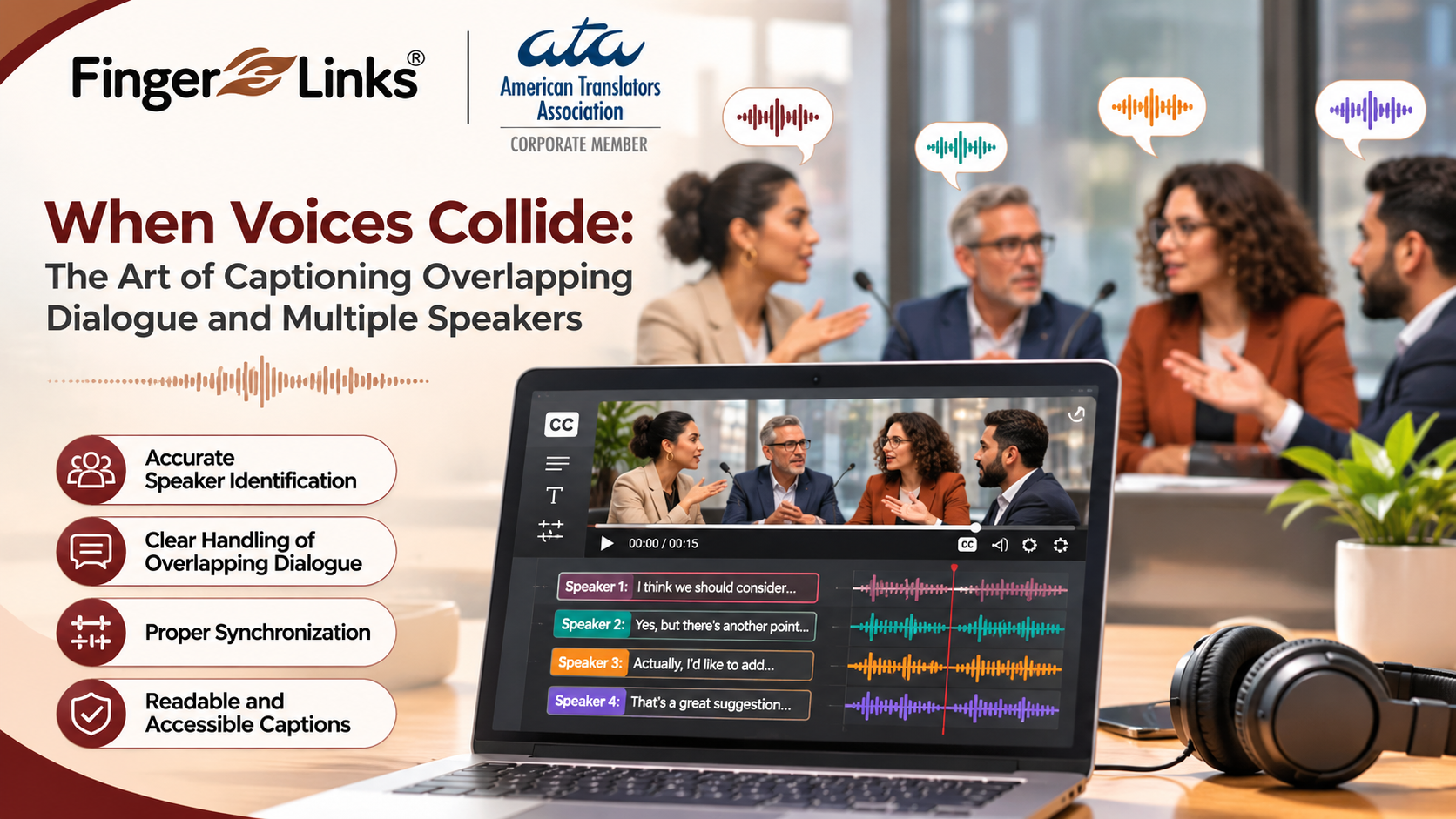
When Voices Collide: The Art of Captioning Overlapping Dialogue and Multiple Speakers
- ⏰ November-24-2026 |
- ✍️ By Admin |
- 🏷️ In Captioning
Conversations do not always follow a perfectly organized sequence. In interviews, panel discussions, courtroom proceedings, business meetings, webinars, and documentaries, multiple individuals may speak simultaneously, interrupt one another, or respond before another speaker has finished. While these interactions create natural and engaging conversations, they introduce significant challenges for captioning professionals.
Captioning such content requires more than converting spoken words into written text. It involves identifying individual speakers, distinguishing simultaneous conversations, maintaining synchronization, and presenting information in a format that viewers can follow without confusion.
Understanding the Challenge of Overlapping Dialogue
Overlapping dialogue occurs when two or more individuals speak at the same time. This frequently happens during debates, group interviews, discussions, and live events.
For captioners, identifying every speaker and accurately capturing their words can be difficult, particularly when voices have similar tones or when conversations become fast-paced.
A poorly structured caption may combine different statements into one sentence, making it difficult for viewers to understand who said what. Professional captioning addresses this issue by carefully separating dialogue and preserving the original conversational context.
The Importance of Accurate Speaker Identification
Speaker identification plays a crucial role in multi-speaker captioning. Viewers must be able to distinguish between participants, especially when several people contribute to the same discussion.
Speaker labels, names, or consistent identifiers help establish who is speaking. Captioners must also pay attention to changes in speaking order, interruptions, and responses to ensure that each statement is attributed correctly.
This is particularly important in legal proceedings, corporate meetings, interviews, and research discussions, where speaker attribution can significantly influence the interpretation of information.
Managing Interruptions and Simultaneous Conversations
Interruptions are a natural part of human communication. Participants may complete another person's sentence, disagree, ask questions, or begin speaking before the previous speaker has finished.
Captioning professionals must represent these exchanges without making the text difficult to read.
Some important considerations include:
-
Separating overlapping statements wherever possible.
-
Maintaining the correct sequence of dialogue.
-
Representing interruptions and unfinished sentences appropriately.
-
Avoiding confusion between different speakers.
-
Preserving the original meaning and conversational flow.
The objective is to communicate what happened in the recording without unnecessarily simplifying the conversation.
Balancing Readability with Caption Accuracy
When several people speak simultaneously, displaying every word at once can create overcrowded captions. This can affect reading speed and make it difficult for viewers to process information.
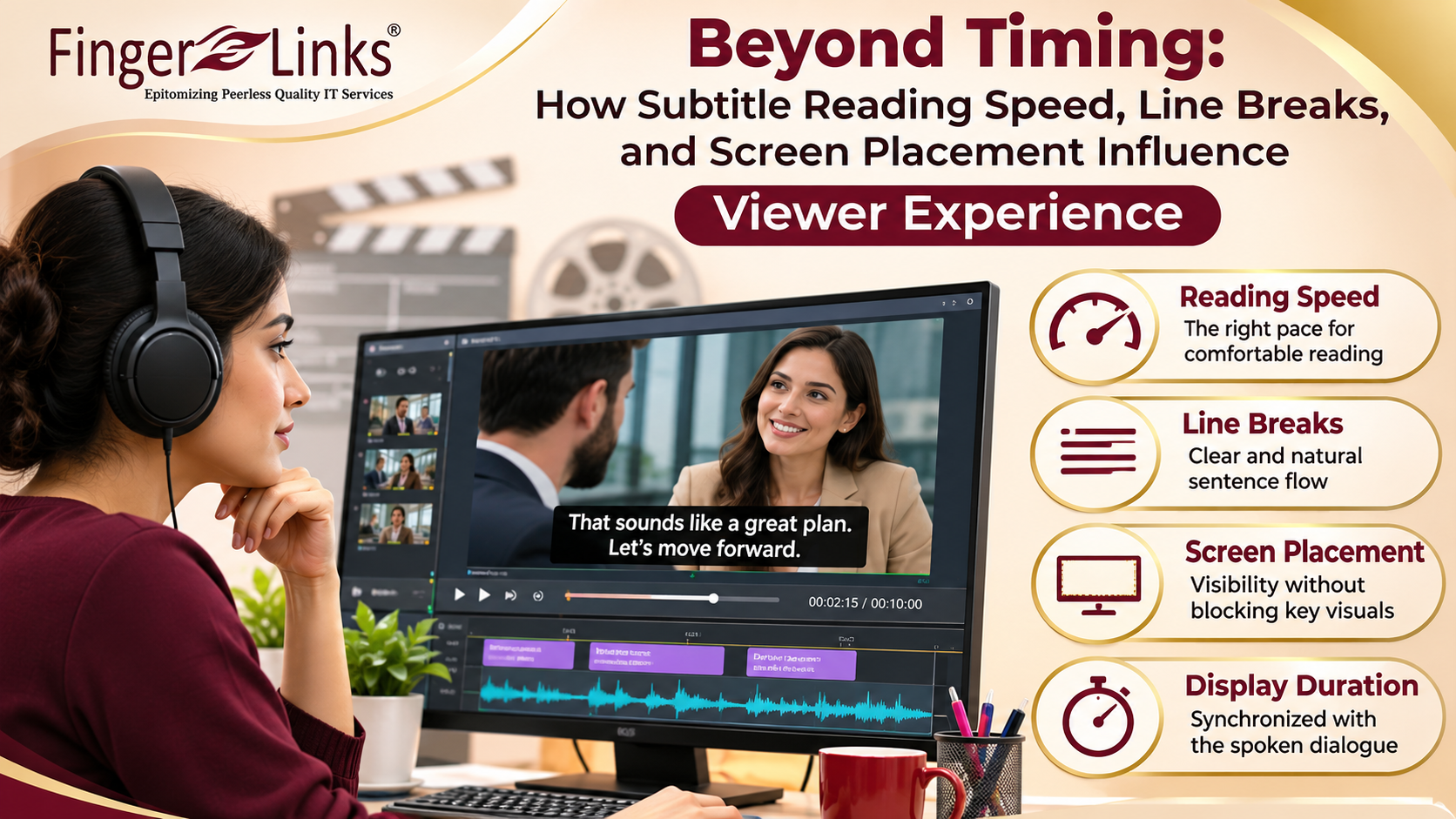
Captioners must consider line length, reading speed, synchronization, positioning, and the duration for which captions remain on screen.
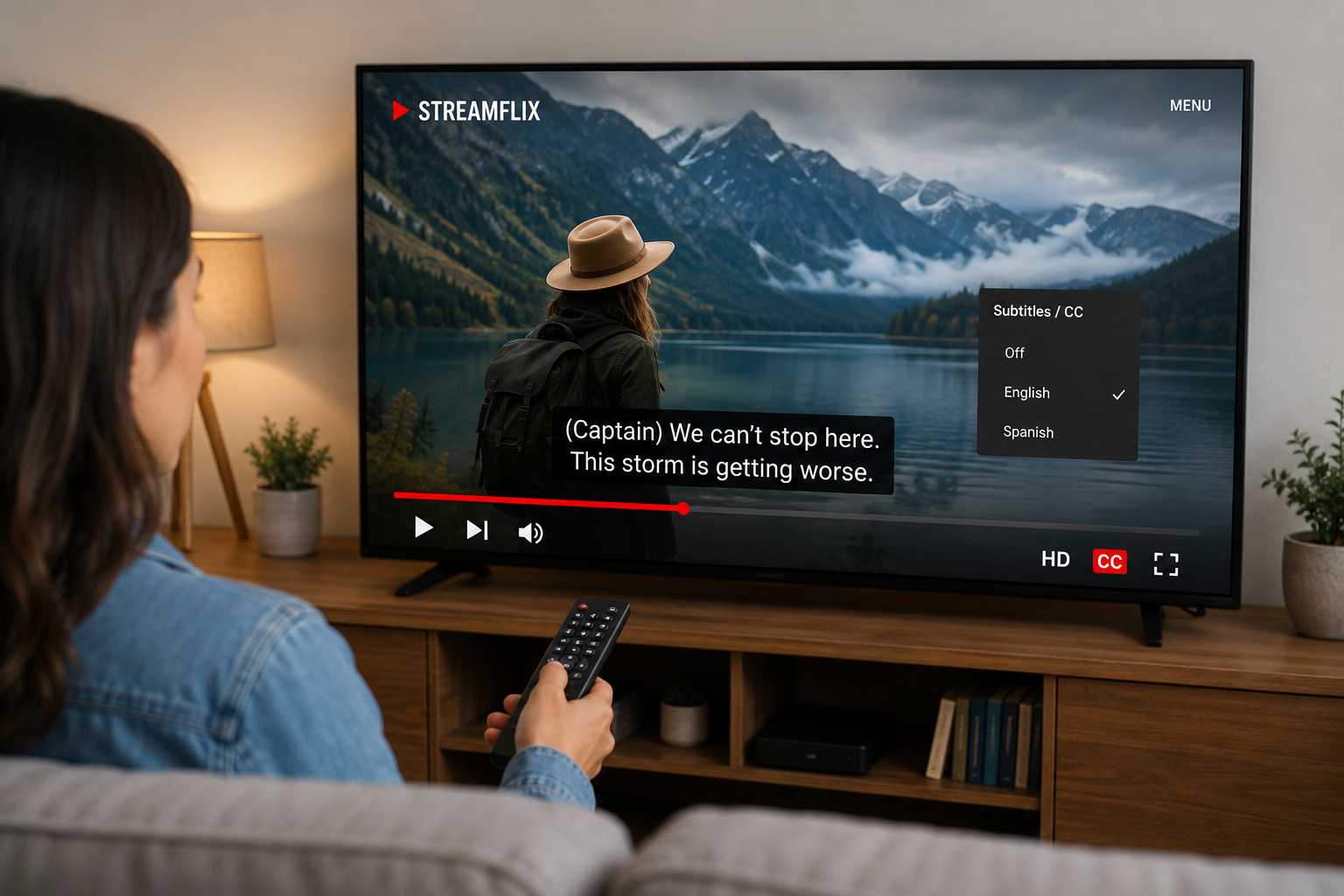
Strategic caption placement and well-structured text can help viewers distinguish between speakers while following the conversation comfortably.
Accuracy should remain the priority, but it must be balanced with readability and accessibility.
The Role of Technology and Human Quality Control
AI-powered speech recognition tools can assist with identifying speech and generating initial captions. However, overlapping voices, background noise, interruptions, and similar-sounding speakers can affect automated results.
Human review remains important for verifying speaker attribution, correcting missed dialogue, checking punctuation, and ensuring that captions accurately represent the recording.
A combination of technology and professional quality control can improve consistency and help deliver reliable captioning results.
Why Professional Multi-Speaker Captioning Matters
Accurate multi-speaker captioning is valuable across several industries:
-
Legal: Court hearings, depositions, witness interviews, and legal discussions.
-
Corporate: Meetings, conferences, presentations, and team discussions.
-
Education: Classroom discussions, lectures, interviews, and group learning sessions.
-
Media and Entertainment: Documentaries, talk shows, panel discussions, and interviews.
-
Market Research: Focus groups, customer interviews, and moderated discussions.
In each setting, accurate speaker identification and properly synchronized captions help preserve the original information.
How FingerLinks Supports Professional Captioning
At FingerLinks, we understand that every conversation carries important information, even when multiple voices compete for attention.
Our captioning and subtitling services focus on delivering clear, synchronized, and contextually accurate captions for different types of audio and video content.
By combining professional expertise, attention to detail, and quality control, FingerLinks helps businesses and content creators make their recordings more accessible and easier to understand.
Conclusion
When multiple voices collide, captioning becomes a careful process of listening, identifying, organizing, and presenting information. Every speaker contributes to the conversation, and every important statement deserves accurate representation.
Professional captioning ensures that overlapping dialogue does not become an obstacle to understanding. With the right balance of technology, human expertise, and quality control, even the most complex conversations can be presented clearly and accessibly.
FingerLinks – Making Every Voice Count.