Bounding Box Annotation: Powering Accurate Computer Vision
- ⏰ August-14-2026 |
- ✍️ By Admin |
- 🏷️ In Data Automation
Bounding Box Annotation: A Foundation for Accurate Computer Vision Models
Artificial intelligence is transforming how machines understand images and videos. From self-driving vehicles and smart surveillance systems to retail analytics and medical imaging, computer vision models need large amounts of accurately labeled visual data to perform effectively. Bounding box annotation is one of the most widely used techniques for preparing this training data.
What Is Bounding Box Annotation?
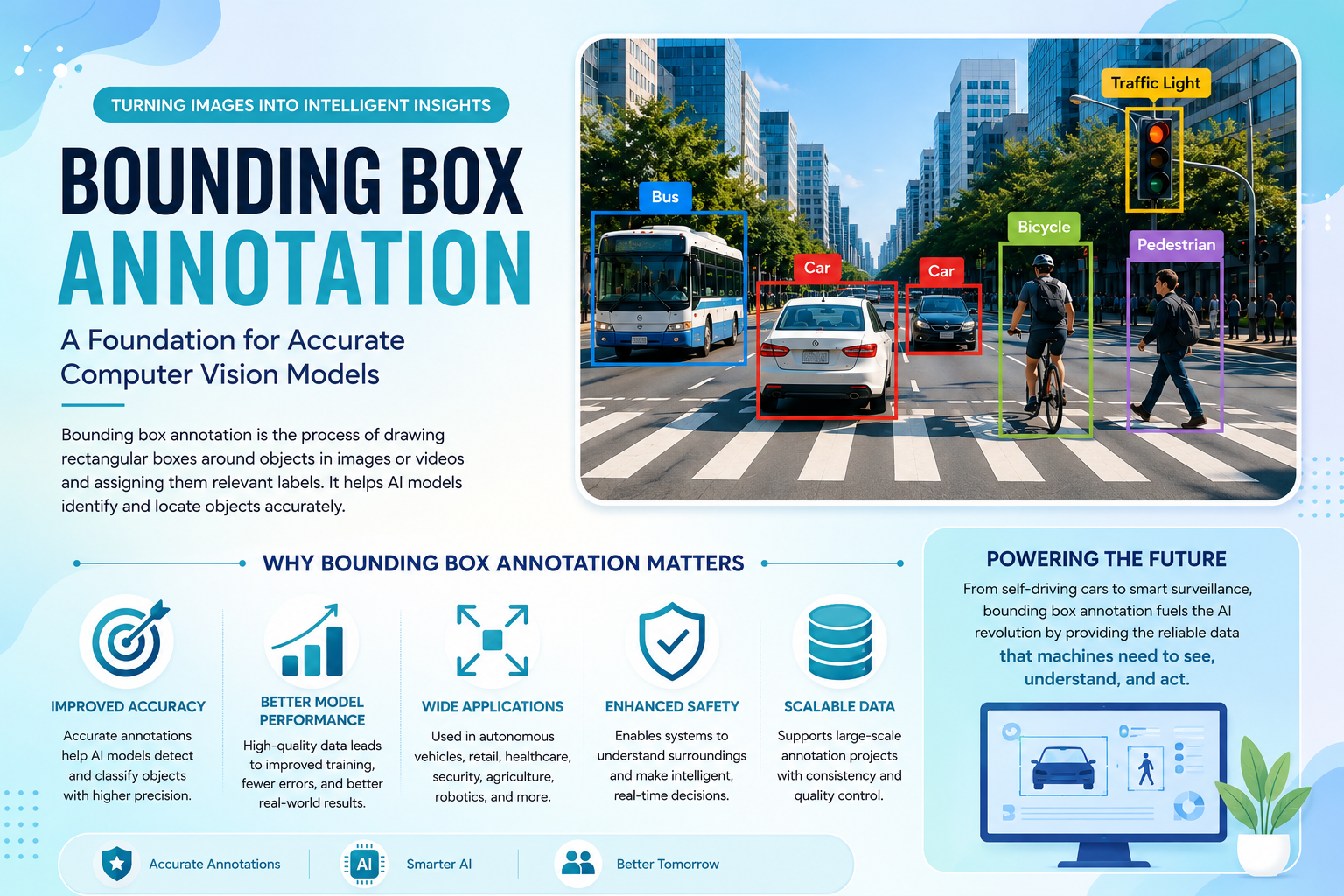
Bounding box annotation is the process of drawing a rectangular box around an object within an image or video frame and assigning it a relevant label. The box identifies the object's location, while the label tells the AI model what the object represents.
For example, in an image containing cars, pedestrians, and traffic signs, annotators can draw individual boxes around each object and label them as “car,” “pedestrian,” or “traffic sign.” Thousands or millions of these annotated examples can then be used to train machine learning models to recognize similar objects automatically.
How Does Bounding Box Annotation Work?
The process generally begins with collecting images or video frames relevant to a particular AI application. Human annotators then identify the objects that need to be recognized and draw boxes as closely as possible around them.
Each annotation typically contains:
-
Bounding box coordinates – The position and dimensions of the box.
-
Object class – The category assigned to the object.
-
Image or frame information – Details that identify the source image or video frame.
-
Additional attributes – Information such as object visibility, size, or condition when required by the project.
The annotated data is reviewed for accuracy before being provided to AI and machine learning teams for model training.
Applications of Bounding Box Annotation
Bounding box annotation is used across many industries and AI applications.
Autonomous Vehicles: Vehicles use computer vision to identify cars, pedestrians, cyclists, road signs, and other objects. Accurate annotations help models recognize these objects and understand their positions.
Retail: Retail businesses can use annotated images for product detection, shelf monitoring, inventory management, and customer movement analysis.
Security and Surveillance: Bounding boxes help AI systems identify people, vehicles, suspicious objects, and other relevant elements in surveillance footage.
Healthcare: Medical images can be annotated to identify specific areas of interest, abnormalities, or anatomical structures, depending on the application.
Agriculture: AI-powered agricultural systems can use annotated images to identify crops, fruits, weeds, pests, and signs of plant damage.
Drones and Robotics: Robots and drones rely on object detection to identify and interact with objects in their surroundings.
Why Annotation Accuracy Matters
The quality of training data directly affects the performance of an AI model. Incorrectly positioned boxes, missing objects, inconsistent labels, and overlapping annotations can introduce errors into the training dataset.
High-quality bounding box annotation requires careful attention to object boundaries, consistent labeling standards, and proper handling of partially visible or overlapping objects. Quality control procedures are therefore an important part of any annotation project.
Bounding Box Annotation vs. Other Annotation Methods
Bounding boxes are particularly useful when the goal is object detection. However, they are not suitable for every computer vision requirement.
Polygon annotation follows the exact shape of an object and can provide more detailed information than a rectangle.
Semantic segmentation assigns a class to individual pixels, allowing models to understand the precise regions occupied by different objects.
Keypoint annotation identifies specific points on an object, such as joints on a human body.
The appropriate annotation method depends on the requirements of the AI model and the intended application.
The Role of Professional Data Annotation Services
Large-scale AI projects often require thousands or millions of images to be labeled according to precise guidelines. Professional data annotation teams can help organizations manage these projects by providing trained annotators, quality control processes, standardized labeling practices, and scalable production.
For businesses developing computer vision solutions, high-quality annotated datasets can provide a strong foundation for building reliable AI models.
Conclusion
Bounding box annotation is a fundamental component of computer vision data preparation. By accurately identifying objects and their locations within images and videos, it provides AI models with the structured information they need for object detection and recognition.
As computer vision continues to expand across transportation, healthcare, retail, agriculture, security, robotics, and other industries, the demand for accurate and scalable image annotation is expected to grow. Investing in high-quality annotation and robust quality control can help organizations build better datasets and support the development of more reliable AI applications.