How Named Entity Recognition (NER) Automates Data Extraction from Unstructured Text?
- ⏰ August-22-2026 |
- ✍️ By Admin |
- 🏷️ In Data Automation
Businesses generate enormous amounts of textual information every day. Emails, customer reviews, legal documents, medical records, reports, invoices, social media posts, support tickets, and business documents all contain valuable information. However, much of this information is stored as unstructured text, making it difficult and time-consuming to process manually.
This is where Named Entity Recognition (NER) can help.
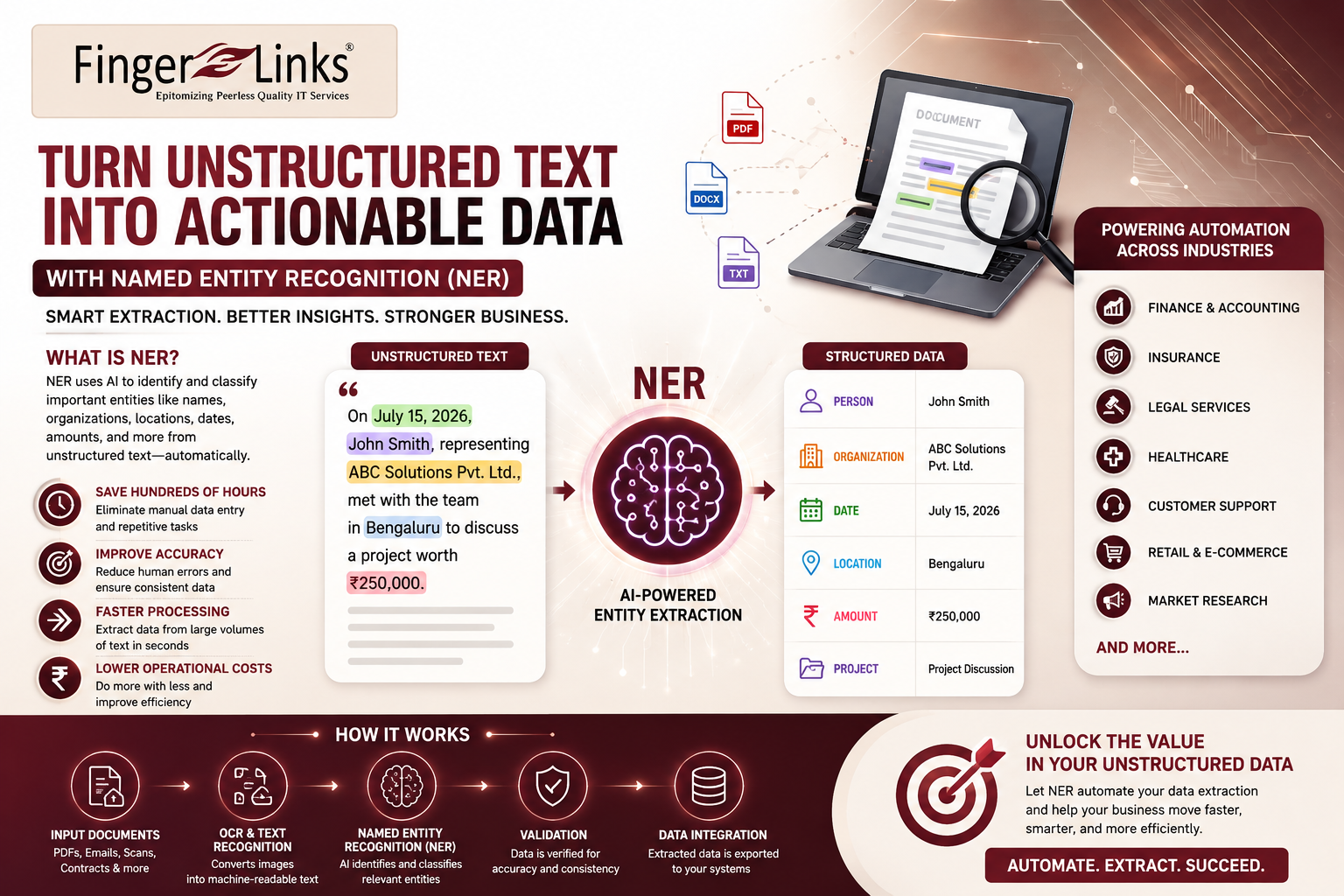
NER is an Artificial Intelligence and Natural Language Processing (NLP) technique that identifies specific entities within a piece of text and assigns them meaningful categories. Instead of treating a document as a collection of words, NER helps a system recognize important information such as people, organizations, locations, dates, products, monetary values, and other relevant entities.
What Is Named Entity Recognition?
Named Entity Recognition is a process used to locate and classify specific pieces of information in text.
For example, consider the sentence:
“John Smith from ABC Technologies visited Chennai on August 15, 2026.”
An NER system could identify:
- John Smith → Person
- ABC Technologies → Organization
- Chennai → Location
- August 15, 2026 → Date
Instead of leaving this information buried inside a paragraph, the system can convert it into structured data that can be stored, searched, analyzed, or transferred to another business system.
How NER Automates Data Extraction
Traditional data extraction often requires employees to read documents and manually copy relevant information into spreadsheets, databases, or business applications. This process can be repetitive, slow, and susceptible to human error.
NER automates much of this work through several stages.
1. Collecting Unstructured Text
The process begins with text collected from different sources, such as:
- Documents and PDFs
- Emails
- Customer reviews
- Websites
- Chat conversations
- Support tickets
- Legal documents
- Medical records
- Social media content
- Business reports
The text may contain useful information mixed with large amounts of irrelevant content.
2. Processing the Text
The text is processed using NLP techniques so that the system can understand its structure and context.
Depending on the application, preprocessing may include removing unnecessary characters, identifying sentences, separating words, and preparing the text for entity recognition.
3. Identifying Relevant Entities
The NER model analyzes the text and identifies words or groups of words that represent specific entities.
For example:
“Global Tech Ltd signed a contract worth $250,000 in Bengaluru on July 10.”
The system could identify:
Global Tech Ltd → Organization
$250,000 → Monetary Value
Bengaluru → Location
July 10 → Date
4. Classifying the Entities
After identifying an entity, the system assigns it a category. The categories depend on the business requirement.
Common entity types include:
| Entity | Example |
|---|---|
| Person | John Smith |
| Organization | ABC Technologies |
| Location | Chennai |
| Date | August 15, 2026 |
| Money | ₹50,000 |
| Product | iPhone 17 |
| Event | Business Conference |
| Address | 25 Main Street |
| Percentage | 25% |
Custom entities can also be created for specific industries and business workflows.
5. Converting Text into Structured Data
The extracted information can then be converted into a structured format.
For example:
Source text:
“ABC Insurance received a claim from David Kumar for ₹2,50,000 following an accident in Coimbatore.”
Extracted information:
- Organization: ABC Insurance
- Person: David Kumar
- Amount: ₹2,50,000
- Location: Coimbatore
- Event: Accident
This structured information can then be sent to databases, CRM systems, analytics platforms, or other applications.
Why NER Is Important for Data Automation
Reduces Manual Data Entry
Employees don't have to manually search through thousands of documents to find specific information. NER can process large volumes of text and identify relevant entities automatically.
Improves Data Processing Speed
A large collection of documents can take hours or days to review manually. Automated entity extraction can significantly reduce processing time.
Helps Reduce Human Errors
Manual copying can lead to missing information, incorrect spelling, duplicate entries, and incorrect values. Automated extraction provides a consistent approach to identifying information.
Makes Unstructured Data Usable
One of the biggest challenges businesses face is that valuable information is often hidden in unstructured text. NER helps transform this information into structured data that can be searched, analyzed, and used in automated workflows.
Supports Business Intelligence
Once information has been extracted and structured, businesses can analyze it to identify trends, customer behavior, important entities, and operational patterns.
Real-World Applications of NER
1. Customer Support
NER can identify customer names, products, locations, order numbers, and other important information from support tickets.
This can help businesses automatically categorize and route customer requests.
2. Legal Documents
Legal organizations handle contracts, agreements, case documents, and other text-heavy records.
NER can identify:
- Names of parties
- Organizations
- Courts
- Dates
- Laws
- Case numbers
- Locations
This can make document organization and information retrieval more efficient.
3. Healthcare
Medical documents contain large amounts of text that can include patient information, medical conditions, medications, procedures, and healthcare providers.
NER can help identify and categorize relevant information for appropriate downstream processing.
4. Insurance
Insurance companies process claims, policies, customer records, accident reports, and other documents.
NER can extract information such as:
- Policy numbers
- Customer names
- Claim numbers
- Locations
- Dates
- Vehicle information
- Claim amounts
This can support faster document processing and automated workflows.
5. Financial Services
Financial documents contain names, companies, account-related information, transaction details, monetary values, and dates.
NER can help extract and organize relevant information for analysis and processing.
6. Market Research
Businesses can process reviews, articles, social media content, and customer feedback to identify organizations, products, locations, and other entities mentioned by users.
This can help companies organize large volumes of market information.
NER and Other Data Automation Technologies
NER becomes even more useful when combined with other automation technologies.
For example:
OCR → NLP → NER → Data Validation → Database Integration
A scanned document can first be processed using OCR to convert the image into text. NLP techniques can then process the text, while NER identifies important entities. Validation rules can check the extracted information before it is transferred to a database or business application.
This creates an end-to-end automated data processing workflow.
Challenges in NER
Although NER can provide significant benefits, extracting information from real-world text can be challenging.
The same word may have different meanings depending on context. Names may also be written in different formats, organizations may have abbreviations, and documents may contain spelling variations.
Industry-specific terminology can create additional challenges.
For this reason, businesses may require domain-specific NER models, customized entity categories, quality checks, and human review for complex cases.
The Future of NER in Data Automation
As AI and NLP technologies continue to improve, NER is becoming increasingly useful for processing large amounts of unstructured information.
Modern systems can combine NER with machine learning, generative AI, OCR, document processing, and workflow automation to create more intelligent data-processing solutions.
Instead of simply extracting information, automated systems can increasingly identify, classify, validate, organize, and route information based on business requirements.
Conclusion
Named Entity Recognition provides an effective way to turn unstructured text into structured information. By automatically identifying people, organizations, locations, dates, monetary values, products, and other important entities, NER can reduce manual processing and help businesses handle large volumes of text more efficiently.
For organizations dealing with documents, emails, customer interactions, legal records, insurance claims, healthcare information, or other text-heavy workflows, NER can become an important component of a broader data automation strategy.
When combined with OCR, NLP, data validation, and system integration, NER can help transform scattered textual information into structured data that businesses can actually use.